Showing posts with label Tangled Up In Tunes. Show all posts

Monday, August 7, 2017

Alpine Valley Revisited, 35th Anniversary


During the summer of 1982, a few weeks after seeing Jerry Garcia Band at Music Mountain, I met my friend Doug to shoot hoops at Tennyson Park, in my hometown of Nanuet, New York.  Doug was waiting for me, leaning against his yellow Caddy and spinning a red, white, and blue ABA basketball on his index finger. The windows were rolled down, and “Casey Jones” was cranking. He said, “Howie, I got a proposition for you. You’re gonna love this idea. It’s right up your alley. The Dead are in Wisconsin next weekend at the Alpine Valley Music Theatre. We can get tickets from Ticketron. Howie, picture this: We are outdoors with Jerry in the Midwest next Saturday night. I hear this place is amaaaaazing! Can you imagine how hot Garcia will be in the Midwest? It’s only a sixteen-hour drive. Let’s do it. Whattaya say?”

 I pulled up in front of the Doug’s house in my maroon Chevy Caprice Classic before noon on Friday, August 6. We wanted to tackle the bulk of our sixteen-hour-trip in one day and cruise into East Troy, Wisconsin, triumphantly on Saturday. Doug emerged from his house with a duffel bag slung across his torso and a box of Maxell cassettes carefully balanced in his right palm like a tray with Dom Perignon. Stepping into my car, he admired his precious cargo and said, “Howie, these tapes are bad news for Van Halen fans.” It was a smug remark—one that a Garcia junkie could appreciate. Comparing anybody to Jerry was comical to us. We understood Garcia’s virtuosity, and we had to let everybody else know. Despite the fact that the Dead’s latest studio efforts were lame, the legend of Garcia was growing, and his cult following was on the rise. 

I picked up two other cats and headed on to 80 West and claimed the fast lane and refused to budge—left hand steering, right hand juggling java, joints, Marlboros, and boots. Endless Pennsylvania seemed bleak—blue collar town followed blue collar town through Amish Country, insane amounts of highway construction and detours along the way. We ran into three thunder storms, or maybe it was the same one chasing after us. A couple of hours after the sun set, we crossed the Ohio border and stopped for food in Youngstown. This was as far west as I’d ever traveled in my life. Fueled by caffeine, and perhaps a bit of yayo, I managed to make it to a rest area just across the border of Indiana and slipped into a spot between tractor trailers for a nap around 4AM. Four Deadheads and 100 truckers were motionless beneath the stars, but they were still tearing down the road in their dreams. 

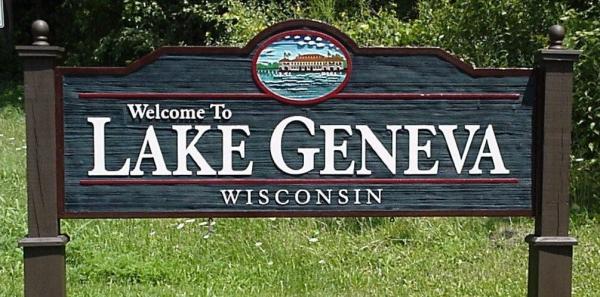
On Saturday morning, we blew by Chicago, purchased a road map, and found a quaint cabin in Lake Geneva by noon. We had stumbled upon a wonderful Wisconsin resort town, and the weather was perfect—ah-hoooo! Cotton-candy clouds in sapphire skies dangled over a crystal clear lake. This expedition turned up nothing but gold, and the impending jam was still a seed in Jerry’s mind. 


Our heroes opened with a Music Never Stopped -> Sugaree ->Music Never Stopped loop. The band had rewarded me for my dedication with a combination that was never played before and would never be played again. This alone validated the journey to Wisconsin. In the middle of the set they played the only version of “On the Road Again” that I would see. Garcia raged on, peppering away on the set ending “Let It Grow.” Weir shouted the lyrics at Jerry, begging him to deliver: “Let it grow, let it grow, greatly yield.” And yield, Garcia did. It’s a guitar lover’s feast offering three separate instrumental segments. The long, sophisticated middle jam contained three distinctive movements within—smoking hot and balanced like a complex mathematical equation. Over the past 35 years I’ve probably listened to this version 5,000 times. 

Set two opened with a robust Cat > Rider. After 1974, the best Cats are from the 81-82 period. After drums there was an extraordinary Wheel > Playin’ followed by a Dew that was incredibly exciting in the moment, but the big jam was unusually short. This was the tenth show of the 152 I’d see over the years, and the power of this music has proven to be eternal. What a great call it was to make the pilgrimage to Alpine Valley. I was only nineteen, and much wiser than I ever realized. 

 Check out my new book:  Dylan and the Grateful Dead: A Tale of Twisted Fate on Amazon 


Other books by Howard F, Weiner 


Sunday, July 28, 2013

Anatomy of a Pilgrimage in Hoboken


My latest  Dylan pilgrimage began in The Bronx with a trip to Woodlawn Cemetery. As I was standing beneath the shade of the  tree hovering over Duke Ellington’s grave, I stared at the resting place of Miles Davis.  Up on the hill, I saw the tombstones of two jazz legends who played with Miles in the ‘50s: Jackie Mclean, Max Roach.  On this brilliant summer afternoon, I stood there with Miles and Sir Duke while listening to In A Silent Way in its entirety.   I then jumped on the 4 Train,  and transferred to the  2 Train to meet up with my accountant and dentist at Tobacco Road in Hell’s Kitchen. After chilin’ and jokin’, we went  to see Dylan in Hoboken.
In a Hoboken parking garage, we tailgated to Tempest, prior to enjoying cocktails at an outdoor bar on Sinatra Drive. I had planned on being inside the show for Morning Jacket and Wilco, but we got caught up watching the beautiful people of Hoboken parading around on Friday night. Anyway, we could hear the bands pretty good right where we were, and we were duly impressed. At 9 PM I made my move to buy a ticket. The first person I asked about an extra ticket handed me a freebie. Ask and you shall receive.
“Love Sick” sounded hot, but the  sound system wasn’t very powerful, and lots of Yuppies were chirping and chattering. The view of Manhattan from the Pier is spectacular.  I worked my way closer to the sound system and Dylan. I bumped into some acquaintances and noticed Charlie Sexton was back on lead guitar tonight. There hasn’t been  this kind of shuffling in Dylan’s band since the G.E. Smith replacement tryouts of 1990. The Tempest songs sounded fabulous, as expected, and “Tangled Up in Blue was one of the best versions I’ve seen in a long time. Dylan had an interesting, high pitched vocal inflection on every word that rhymed with Blue---youuuuuu…shoeeeee….
Dylan’s set lists have been stagnant the last few times I’ve seen him, but, how can I not love seeing
“A Hard Rain’s A-Gonna  Fall,” Blind Willie Mc Tell,” and “Simple Twist of Fate” in succession?  Bob’s harp playing was simple and tasteful throughout. His solos on Blind Willie were absolutely hypnotic. “Summer Days” featured a sophisticated jam with twists, turns, and detours. Dylan stirred the stew, but by design, he never brought it to boil. For the first time, in about my last forty or fifty shows, there was no “Thunder on the Mountain.” I missed it, that rocker had become the instrumental highlight of Bob’s sets. 

Hearing “The Weight” was quite a thrill. The Dylan handled the first verse and I sweat he did sing great, before deferring the other verses to his on stage guests. Watchtower and Thin Man  finished off another memorable night  with Dylan, a night mostly spent shuffling on the grass by the pier with the Manhattan Skyline as the backdrop. After the show , my accountant drove us to Chinatown. At 2PM there was a line to get into Wo Hop’s. We waited anxiously until we devoured our feast.  I’ve been rolling with Dylan’s Never Ending Tour for the past twenty-five years, and he always delivers the inspiration. The train keeps a-rollin’. Here’s to the next twenty-five!

Monday, June 10, 2013

Tony Garnier Joins Dylan's Band! 6-10-89

24 Years later, Dylan and Garnier are still happily married. Here's a brain-busting Like a Rolling Stone from 6-10-89 from Statenhal, Den Haag, The Netherlands. This is a favorite of mine. Dylan's vocals are urgent, and the guitar solo from, G.R. Smith smokes!


For more on the Never Ending Tour, check out Tangled Up in Tunes: Ballad of a Dylanhead

Thursday, June 6, 2013

Birth of the Never Ending Tour Revisited


Twenty five years ago on this day, June 7, Dylan launched what was to become known as the Never Ending Tour in Concord, California. I was fortunate to catch six Dylan shows in 1988. Here are my fond recollections of those performances:

6-24-88 Garden State Performing Arts Center…Dylan burst upon  the stage playing a frenetic Subterranean Homesick Blues opener followed by It’s All Over Now Baby Blue. Dylan and G.E. Smith were kicking ass and taking names.  I was stunned by the brazing versions of Drifting Too Far From Shore and Silvio, a massive improvement  over the tepid, but enjoyable album tracks.  Like a Rolling Stone was the sensational set closer—all ’88 renditions of Bob’s greatest anthem are sure to please. This was the first time I had ever seen Dylan without Petty or the Grateful Dead backing him—Dylan unfettered. This performance was exhilarating and brisk. I knew I’d be back for more, but I could never have imagined that it would be 119 shows over the course of the next twenty-five years.

7-3-88 Old Orchard Beach Ballpark, Maine…Gratefully blame this one on a simple twist of fate.  I’d seen the Grateful Dead at the Oxford Raceway the night before and was planning on returning for night two. Skimming through a local tabloid, my friend noticed that Dylan was playing at a ballpark in Old Orchard Beach--a hop skip and jump on down the road. With one of the most persuasive speeches of my life,  I convinced him to leave the Dead behind. Adios hippies, Howdy Bob.
Dylan played a batch of songs that I hadn’t heard at GSPAC, including: Tangled Up in Blue, The Ballad of Frankie Lee and Judas Priest, To Ramona, Trail of the Buffalo, and All Along the Watchtower. I waltzed right up to the front of the stage and savored every tune. This intimate experience was the antithesis to what was going on in Oxford in the land of the Dead--100,000 freaks.

9-2-88 Orange County Fair…Tour ’88 steamrolled into Middletown, New York. Dylan raged and G.E. continued to extend his jams confidently as Dylan's repertoire grew and the concerts became longer. On this night, Absolutely Sweet Marie and Seeing the Real You at Last soared. Dylan crooned like a Celtic balladeer on Barbra Allen, and his emphatic cadence on It Ain’t Me Babe brought pleasure to the ladies at the fair. I was hooked. The Grateful Dead’s influence on Dylan was undeniable. Every night Dylan was painting a fresh masterpiece.

10-19-88 Radio City Music Hall…The tour closed out with four nights at Radio City Music Hall. There was a  buzz surrounding these shows due to Dylan’s  momentous tour and the recent release of the Traveling Wilbury’s Volume 1. I attended three of these Radio City Shows. The final night was one for the ages.  The surprise of the opening seven-song electric set was Bob Dylan’s 115th Dream. Bob’s voice was a little cranky at times, but The Dylan is at his best when he’s fighting through hiccups.
Dylan added the Neville Brothers Vietnam verse to a captivating With God on Our Side, to the delight of the audience. The four-song acoustic set was chased by an explosive trifecta: Silvio > In the Garden > Like a Rolling Stone.  In the Garden was mindboggling, transformed from a pleasing gospel number into a venue rattling rocker.
Dylan reached back to Harry Smith’s Folk Anthology for a stunning version of Wagoner’s Lad to launch the five-song encore.  The Lonesome Death of Hattie Carroll followed, yes it was a perfect night. During Knockin’ on Heaven’s Door, Dylan and G.E. traded their acoustics for electrics as the band crashed in. A searing All Along the Watchtower and Maggie’s Farm ended the premier concert from one of the most pivotal years of Dylan’s career. I was there.
He not busy being born is busy dying.
For more on the Never Ending Tour, check out Tangled Up in Tunes: Ballad of a Dylanhead

Tuesday, August 7, 2012

Go West Young Men! 8-7-82

Thirty years ago today. An excerpt from Chapter Four of Tangled Up in Tunes:


Doug was waiting for me in the gravelly Tennyson Park lot, leaning against his yellow Caddy and spinning a red, white, and blue ABA basketball on his index finger. The windows were rolled down, and “Casey Jones” was cranking. He said, “Howie, I got a proposition for you. You’re gonna love this idea. It’s right up your alley. The Dead are in Wisconsin next weekend at the Alpine Valley Music Theatre. We can get tickets from Ticketron. Howie, picture this: We are outdoors with Jerry in the Midwest next Saturday night. I hear this place is amaaaaazing!  Can you imagine how hot Garcia will be in the Midwest? It’s only a sixteen-hour drive. Let’s do it. Whattaya say?” 
The time had come for us to leave the Tennyson Boys behind. Our pursuit of Jerry’s next transcendent jam was paramount. I informed my parents I’d be heading West with Doug in my Chevy. My parents were fond of the Doug. They knew I was crazy, but if Doug was part of my posse, then there might be some merit to it. In the classic tradition of exploration made famous by Lewis and Clark and perpetuated by Kerouac and Cassidy —  look out, America — here comes Catfish and Schmell!
I pulled up in front of the Schmell residence before noon on Friday. We wanted to tackle the bulk of our sixteen-hour-trip in one day and cruise into East Troy, Wisconsin, triumphantly on Saturday, August 7, 1982. Doug emerged from his house with a duffel bag slung across his torso and a box of Maxell cassettes carefully balanced in his right palm like a tray with Dom Perignon. Stepping into my Chevy, he admired his precious cargo and said, “Howie, these tapes are bad news for Van Halen fans.” It was a smug remark—one that a Garcia junkie could appreciate. Comparing anybody to Jerry was comical to us. We understood Garcia’s virtuosity, and it was our mission to spread the word to non-believers. Despite the fact that the Dead’s latest studio efforts were lame, the legend of Garcia was growing, and his cult following was on the rise.  
Chuck and Paul, neighborhood Deadheads, joined us on our journey to Wisconsin. Chuck was a serious young man–Fred Flintstone in tie-dye. He was also a person of great interest to us because he had a substantial bootleg collection, but a bad reputation when it came to returning borrowed tapes. Our other passenger, Paul Blatt, was a tiny red-headed cat I met at Rockland Community College–a mini-Bill Walton, minus athletic prowess. Cordial Paul spoke in soft squeaky tones and was always willing to roll with the flow of the group.  
Charging on to 80 West, I claimed the fast lane and refused to budge—left hand steering, right hand juggling java, joints, Marlboros, and boots. Endless Pennsylvania seemed bleak – blue collar town followed blue collar town through Amish Country, insane amounts of highway construction and detours along the way. We ran into three thunder storms, or maybe it was the same one chasing after us. Sheets of precipitation rap-tap-tapped off the windshield as I raced past monster trailers and trucks on the bedraggled two-lane highway. The sky darkened by the time we reached Ohio. Feeling famished, we stopped for food at a place in Youngstown that had a menu boasting of gizzards. A grease-stained bucket of rest area Roy Rogers chicken would have to suffice. One more cup of coffee, a hit of speed and one more ’77 Dead tape; I refused to give up the wheel until Cleveland was in the rearview mirror. By 3 A.M., my comrades were snoring as I pulled into a rest area and slipped into a spot between tractor trailers.  Four Deadheads and 100 truckers were motionless beneath the stars, but they were still tearing down the road in their dreams.  
On Saturday morning, we blew by Chicago, purchased a road map, and found a quaint cabin in Lake Geneva by noon. We had stumbled upon a wonderful Wisconsin resort town, and the weather was perfect—ah-hoooo! Cotton-candy clouds in sapphire skies dangled over a crystal clear lake. This expedition turned up nothing but gold, and the impending jam was still a seed in Jerry’s mind. 

Our heroes opened with a Music Never Stopped -> Sugaree ->Music Never Stopped loop. Once again, the band had rewarded me for my dedication with a combination that was never played before and would never be played again. Garcia raged on, peppering away on the set ending “Let It Grow.” Weir shouted the lyrics at Jerry, begging him to deliver: “Let it grow, let it grow, greatly yield.” And yield, Garcia did.  It’s a guitar lover’s feast offering three separate instrumental segments, with the middle one being the longest and most complex. The band executed flawlessly, setting the stage for Jerry’s mid-summer tirade. 
I finished out the year seeing the Dead at Landover, Maryland (9-15-82), Madison Square Garden (9-20 + 21-82), New Haven (9-23-82) and Syracuse (9-24-82), as well as catching the Jerry Garcia Band at the Felt Forum (11-11-82 early & late shows) and in the Wilkins Theatre at Keane College, located in Elizabeth, New Jersey (11-15-82 early & late show). In 1983, I got serious about following Jerry around. 

Tangled Up in Tunes: Ballad of a Dylanhead is available at www.tangledupintunes.com The kindle version is on sale through August 9th for $5.99.

Tuesday, July 31, 2012

He Was A Friend of Mine: Happy 70th Birthday Jerry


“There's no way to measure his greatness or magnitude as a person or as a player. I don't think any eulogizing will do him justice. He was that great, much more than a superb musician, with an uncanny ear and dexterity. He's the very spirit personified of whatever is Muddy River country at its core and screams up into the spheres. He really had no equal. To me he wasn't only a musician and friend, he was more like a big brother who taught and showed me more than he'll ever know. There's a lot of spaces and advances between The Carter Family, Buddy Holly and, say, Ornette Coleman—a lot of universes, but he filled them all without being a member of any school. His playing was moody, awesome, sophisticated, hypnotic and subtle. There's no way to convey the loss. It just digs down really deep.”
Bob Dylan’s press release regarding the death of Jerry Garcia’s is one of the most poignant, and perceptive pieces I’ve ever read. It always makes me feel the immediacy of Jerry’s passing as if it just happened, and I know that Dylan gets It. In that glorious paragraph, Dylan sketches the essence of Jerry Garcia, the enlightened soul who gave us everything he had.  
I became a Deadhead on January 24, 1981, after experiencing Europe ’72 in the backseat of my friend’s Honda Civic following a New York Islanders hockey game. On that evening, Michael Bossy became the second player in NHL history to score fifty goals in the first fifty games of a season. It was a thrilling live spectacle, but hearing my first Ramble On Rose on the way home stole the show. The Jerry switch in my brain was flicked on when I heard him croon,
“I’m gonna sing you a hundred verses in ragtime. I know this song it ain’t never gonna end.”
In Jerry’s world, the music never stopped. Songs went on and on, and they melted into exotic combinations: Dark Star > Sugar Magnolia > Caution…Playin’ in the Band  > Uncle John’s Band > Morning Dew > Uncle John’s Band > Playin’ in the Band. The jams fearlessly stormed into unchartered territory, but were seamlessly balanced  like mathematical equations. It all roles into one. 
Buddy Holly, Orrnette Coleman, Eddie Lang, Hank Williams, Bob Dylan; Jerry absorbed them all, and cherished the supernatural spirit of everything that was awesome and wholesome about music. Jerry and his cosmic band mates poured sonic inspiration into a psychedelic blender at Kesey’s Acid Tests, launching a distinctive genre of music that was true its roots—The Grateful Dead.
Perhaps, nobody appreciated other artist’s music more than Jerry. Just consider the songs Jerry Garcia Band tackled: Dear Prudence, Tangled Up in Blue, The Night They Drove Old Dixie Down, Harder They Come, After Midnight, Second That Emotion, Tough Mama, Let it Rock, And It Stoned Me, Russian Lullaby, When I Paint My Masterpiece. I suppose that’s what love will make you do.
Jerry turned me on to Dylan. When the Grateful Dead toured with Bob in 1987, I became the happiest Dylanhead on the planet. A few years later, the Grateful Dead shared the stage with Branford Marsalis at the Nassau Coliseum. That Jerry > Branford jam in Eyes of the World enlightened me to the world of Miles Davis, John Coltrane, and Bud Powell.
Songs were sacred to Jerry. That’s why he slowed down the tempo and prolonged the jam. I know this song, it ain’t never gonna end. Every nook, cranny, and crevice in the valley was explored and magnified. When our lives are in spirit, we want to stop time in its tracks. Jerry could stop time: 9-3-77 Englishtown, 8-27-72 Kesey’s Farm, 9-18-97 Madison Square Garden.
I’ll take a melody
 And see what I can do about it.
I’ll take a simple C to G
And feel brand new about it
“He's the very spirit personified of whatever is Muddy River country at its core and screams up into the spheres,” said Mr. Dylan. Thankfully, Muddy River country still rages in these conformist times. You can hear It on the 24/7 Grateful Dead Channel, and you can see It and feel It in every hippie living the life they love at a summer festival. It’s been seventeen years since Jerry’s passing, and  every year, the big fella  looms larger than ever. I savor his angelic voice every day. And his passionately patient solos scream up into the spheres and beyond.
Thank you Dear Mr. Fantasy. Happy 70th Birthday! You know our love will not fade away. 
Tangled Up in Tunes: Ballad of a Dylanhead is available on Kindle for $5.99 to celebrate Jerry's Birthday. www.tangledupintunes.com
www.tangledupintunes.com

Wednesday, March 28, 2012

Barb Jungr Returns Man in the Long Black Coat to New York

Barb Jungr, the fabulous British singer, is back in New York City to perform her widely-acclaimed Bob Dylan show, Man in the Long Black Coat, at the elegant Metropolitan Room for a three-week run starting on April 10th. Barb's unique interpretations of Bob's songs are absolutely Dylanesque. On her latest CD, Man In The Long Black Coat, Jungr seamlessly mixes Dylan's best known songs with offbeat offerings like "Trouble in Mind," "Sara," and "High Water."
Jungr reconstructs "Trouble in Mind," slowly building it from something that sounds like Peggy Lee's "Fever" to a resounding and inspiring gospel hymn—the type of performance that can only be pulled off by an artist that understands the subtleties and nuances of Dylan's rarest compositions. Her rendition of "Man in the Long Black Coat" is sublime. In one verse she snarls like Dylan, then her voice soars like Joan Baez. The arrangement captures the suspenseful tone of Dylan's original with dynamic, rich texture.
In addition to her ten-year affair with Dylan's oeuvre, Jungr is known for her daring interpretations of compositions by Bruce Springsteen, Leonard Cohen, David Byrne, Neil Diamond, Hank Williams and Elvis Presley. Jungr is a dazzling live performer who delivers an indefinable X-factor with each show. This style mirrors what Dylan does with his own songs in concert.
Time Out New York rated Man in the Long Black Coat the top cabaret show of 2011. Adam Feldman wrote, "The extraordinary English singer didn't just cover Bob Dylan's songs, she uncovered them and discovered them with exuberant musical insight."
If you love Bob Dylan's music, or if you love the thrill of a great live performance, Barb Jungr's show is a must see. Barb serves up the all the iconic songs with fresh twists: "Like A Rolling Stone," The Times They Are A-Changin'," It Ain't Me Babe," "Blind Willie McTell." Man in the Long Black Coat performs a total of 15 times: Tues-Fri April 10, 11, 12, 13, all at 7pm; Sat April 14 at 9:30; Tues-Fri April 17, 18, 19, 20, all at 7pm; Sat April 21 at 9:30pm; Tues-Fri April 24, 25, 26, 27, all at 7pm; Sat April 28 at 9:30pm. The music charge is $25, plus a two-drink minimum.
For reservations call 212/206-0440 or order online www.metropolitanroom.com
For those attending the shows on Saturday, April 14th and April 21st, join Barb and prominent Bob Dylan experts for two intimate pre-show Fireside Chats at 8 PM. The shows start at 9:30.There's no additional charge for the Fireside Chats for the first 30 persons who purchase their tickets online. Just use the password Dylanchat .
In addition to meeting Barb, you'll be able to participate in revealing stories, gossip, and gospel with Q 104's KEN DASHOW (April 14) , Dylan author Howard Weiner (April 14 & 21), and another special guest who will be announced for April 21st.

People don't live or die/ People just float
She gone with the man in the long black coat

www.tangledupintunes.com

Sunday, March 25, 2012

Facebook Induced Flashback: Alpine to Ohio


A friend posted this photo on Facebook today. This is the earliest known photo of me on tour. Doug Schmell is on the left, Howard "Catfish" Weiner on the right. It's 6-25-85 and we're at the River Bend Music Theatre in Cincinati prior to a Grateful Dead concert. Here's an excerpt from Chapter Six of my road memoir: Tangled Up in Tunes: Ballad of a Dylanhead.


TRACK SIX: U.S.BLUES

Grateful Interventions…A preview of the 1985 NBA Draft in the style of Moses Malone…The pros and cons of hitchhikers…Sweating bullets in Cincinnati…Ominous clouds in Buffalo…The party’s over at RFK…

The Alpine shows were tight, welcomed consistency after the Helter Skelter Spring tour. On the second night, the “Saint of Circumstance” jam raged, and The Boys opened the second set with the Derek and the Dominoes classic, “Keep on Growing,” featuring Phil Lesh on lead vocals. Lesh had recently emerged from a ten-year singing hiatus. A new Deadhead chant was born: “Let Phil sing.” I wanted to chant: “Bad idea.” The beloved bassist, who wore tie-dyes and looked like a chemist, had a distinct vocal style—awful as can be. This didn’t matter to Deadheads. Tight-knit crowds crave simplistic mantras to chant. In Yankee Stadium they yell, “Boston sucks,” and in the Boston Garden they holler, “Beat L.A.” When Phil Lesh sang, I cringed.

June 23, 1985, was a travel day. Our crew fiddled around Lake Geneva all day and then started the journey towards Cincinnati by sundown. We picked up a hitchhiking Deadhead who looked like a young Rodney Dangerfield in a Hawaiian shirt. His name was Steve Miller. His sticky bud made us fly like eagles, and his stinky feet made us roll down the windows. We had an intervention and ordered him to put his boots in the trunk. Doug’s Alpine Masters sounded sensational as I pressed on for five hours before pulling over to sleep in an Indiana service area.

Sunshine was beating upon my forehead as I awoke in the front seat of my Chevy. My clothes were heavy with perspiration, and I was steaming like a burrito that had been slowly baking all night. Doug was snoring and schvitzing in the back seat. Steve Miller restlessly rolled on the trunk. Phil and Paul had been napping in sleeping bags on the grass, but I found them having coffee in the cafeteria. Their sleeping quarters were invaded by a bivouac of ants at dawn.
The mid-morning heat was relentless, and there wasn’t a cloud over the Midwest. Our spirits were bolstered again as we headed down the highway with the AC cranking. We reached the River Bend Music Theatre at noon, way too soon—we had seven hours to kill on a 100-degree day.
“Iko Iko,” the righteous party song, kicked-off the second set. Behind the stage, a steamboat slowly sailed up the Ohio River. Look out, mama, there’s a white boat coming up the river. The enormous Grateful Dead twentieth celebration banner dropped down behind the band as they slammed into “Samson & Delilah.” River Bend buzzed below the setting sun.

For their Twentieth Anniversary concerts in Berkeley, the Dead broke out “Cryptical Envelopments,” an Anthem of the Sun beauty that had been sitting on the shelf since 1970. In Cincinnati we were treated to a Cryptical Loop:  Cryptical Envelopments  -> Drums -> Space -> Come A Time -> The Other One -> Cryptical Envelopments. A la 1985, Garcia’s voice crackled through this segment, but the loving intent was palpable.

Driving away from River Bend, I gushed about Garcia’s nifty fretwork on “Let It Grow.” Had I been looking at road signs, I might have been warned about the winding pavement that veered sharply to the right. Without time to stomp on the brakes, I snapped the wheel to my right in a desperate attempt to save myself and my crew from flying off the mountainside. The tires screeched louder than a bullhorn, and my Chevy Caprice was airborne—cups, cans, tapes, pipes, and sunglasses in orbit. I stuck the landing on the road like a gold medal skier in the downhill, still cruising at a 60 MPH clip. My crew was silenced with acute shock syndrome. 

Tangled Up in Tunes is available at www.tangledupintunes.com This 1978 Chevy Caprice is a dead ringer for my tour mobile.

Saturday, March 3, 2012

Hampton Here We Come!

Excerpt from Chapter Four of Tangled Up in Tunes

 The Music Never Stopped

Seagulls with massive wingspans glided around us; other seagulls were perched on the rail preparing for takeoff.  Brilliant sunshine bounced off the Chesapeake Bay as the Dead thundered in my Chevy. Doug rocked back and forth—a devotee in a contented trance. As the velocity, pitch, and poignancy of Jerry’s guitar intensified, Doug’s mug glowed–stunned admiration. Pointing at the tape deck as if Garcia was in our presence, Doug said, “This is deranged. How does Jerry think of this stuff?”

I wondered when we might see land again. We’d been on the Chesapeake Bay Bridge for fifteen minutes, and there was just water, road and birds ahead and water, road and birds behind. I was driving straight into an Alfred Hitchcock sequel. It then occurred to me that I was, in fact, driving. I was so stoned I forgot I was captain of the ship.

There were three hipsters in my backseat—Doug’s Deadhead companions from SUNY Albany—Stempel, Genowa and Beehaw. They were quiet cats. Their very names seemed to do all the talking for them. Our destination was Hampton, Virginia: Waffle House, Holiday Inn, hippie chicks, Grateful Dead. Paradise Waits.
Hampton was usually the first stop on the Grateful Dead’s spring tour. For some people, spring begins when the first pitch is tossed from the mound at Yankee Stadium. For Doug and me, and thousands of other Deadheads, crossing the Chesapeake Bay Bridge signified the commencement of spring.

There are few pleasures commensurate to roaring down the road while the tunes are-a-thundering. Audio transcendence is possible as long as your car can rev up to seventy without rattling, and the windows are rolled up. Yes, the windows must be sealed to bounce the sound around so you eardrums are filled with nothing but rhythm and melody. You breathe in guitar and exhale staccato bursts of air, in an attempt to echo the singers. The bass rattles your bones as the organ sweeps through the pores of your skin. A tiny portion of our brains can handle driving while all this goes down. Accessing that nugget of my mind, I delivered us to the Hampton Coliseum safely on April 9, 1983.

As the boys tuned up for the second set, I identified the sacred twangs from Jerry's guitar. Doug and I grabbed each other and yelled, “Help on the Way!” hugging and jumping in time to Phil’s thumping bass. The rest of the band continued to doodle aimlessly. If this turned out not to be “Help on the Way,” our premature celebration would have looked pretty silly. Luckily, it was the tune we craved. It had been six long years since the Grateful Dead played "Help on the Way" on the East Coast. These were glorious times.
Tangled Up in Tunes: Ballad of a Dylanhead www.tangledupintunes.com

Wednesday, February 22, 2012

A Deadhead Born This Morning

Philly Spectrum 4-6-82

I sought The Holy Grail, “Morning Dew.” A rarely-played jewel, The Dead only played the Dew when they had IT going on.  A cyclone of psychedelic sound was unleashed in the jam between “Truckin” and “The Other One.” I hollered and yodeled approval; the band was ripping. Now I had mental telepathy working: The Dew, Jerry. For the love of God, please play the Dew. Weir sang, “Cowboy Neal at the wheel, the bus to never ever land; Coming, coming, coming around; coming around, coming around; coming around.” The time had come.

A fractioned second of silence framed the moment. Jerry struck the magic Dew chord.


            Oh, the humanity! I grabbed Scott by the waist and proudly hoisted him over my head like he was the Stanley Cup Trophy. A young lady standing in front of me let out two primal, erotic screams. Pandemonium in Philly! Folks were crying, hugging, kissing, and squeezing each other.
Jerry’s solitary voice emerged: “Walk me out in the morning dew my honey; walk me out in the morning dew today.” The tempo was dirge-like, almost still. Jerry appeared egoless, just standing there in black t-shirt and jeans. He poured his soul into each syllable, seemingly stopping time, freezing the moment, connecting with the raw emotion of the masses: “I thought I heard a baby cry this morning; I thought I heard a baby cry today!”  
            Jerry compressed a screaming tirade of notes into his solo, punctuated by a resounding blast from Phil’s bass. Jerry’s solitary voice returned, more solemn than before, repetitiously crying, “I guess it doesn’t matter anyway.” Silence filled the arena. Deadheads prepared for takeoff.
Garcia began his sermon deliberately, plucking strings with surgeon-like precision. He was immobile nobility—his bearded mug intense, his brain boiling. Each note radiating from his fret board did so with intimacy. Each note was crucial. The band followed in a trance, adding layers and waves of aural sensation. As the foundation solidified, the velocity and volume of Jerry’s playing spiraled until the steam valve blew. Each musician was engaged in the spectacular display—they scaled the pyramid of transcendence together.  The wall of sound crashed down. Jerry mournfully wailed, “I guess it doesn’t matter, anyway ay ay ayyyyy!”
Overwhelmed by the Dew, I didn’t care what was next. I let out a lunatic’s laugh as the band burst into “Sugar Magnolia.” Sweat poured as Deadheads bounced off the Spectrum floor like it was a trampoline. This was the exclamation point for a historic set. The boys delivered my wish list: Shakedown Street, Terrapin Station, Morning Dew, Sugar Magnolia. It was the only time in Grateful Dead history that those four songs appeared together in the same show. Just once in 2,314 concerts. Was it a coincidence, or was my presence part of the equation? 
Much like the sports fan who goes to his favorite pub week after week and roots for his favorite football team, and wears the same dingy sweatshirt, and sits in the same wobbly stool, and orders the same pint of beer from the same bartender until his team wins the Super Bowl or flops and he realizes the folly of his ways, I believed my presence in Philly inspired the band.
Returning home, we felt sensational. There was something heroic about it all. I was an active participant in the musical process. I knew I’d soon land a bootleg tape of the show and, if I listened close enough, I might even hear myself howling. Musical recordings are breathing snapshots of life and emotion that pass through time and endure in a way that no other art form can.
Cruising along the Palisades Parkway, fifteen minutes from my twin mattress, Seymour suddenly lost control of the wheel. His pillbox Honda hit an ice patch and went spinning like a sock in a dryer.  When the whirling ceased, we were ensconced in a snow drift, a few feet from the towering pines that might have mangled the car. A tragedy was narrowly averted. Miraculously, there wasn’t a scratch on the car or anybody in it. I pried the door ajar, looked up at the star-cluttered sky and pumped my fist into the night. Standing knee deep in snow while waiting for help to arrive, I cut loose with a “Yee-haw, yippie yah-hoo, Jerry is God-od-od-od.” My crazed voice echoed through the valley.
Thirty minutes later, a tow truck yanked the tiny vehicle from its snowy trap. Three teens were on the road again. Scott and Seymour were subdued and shaken. I'd found my calling, and seeking more days like this would dominate my foreseeable future. I was dropped off at my parents’ house, but there was no going home. My heart and soul were on the road with the Grateful Dead.
     
Tangled Up in Tunes Ballad of a Dylanhead is available in paperback or on kindle www.tangledupintunes.com

Monday, February 20, 2012

A Special President's Day Post

Minneapolis, Minnesota 11-04-08
Excerpt from Tangled Up in Tunes: Ballad of a Dylahead

As showtime neared, anticipation and expectation swelled inside Northrop Auditorium. The Prodigal Son had returned. This was Dylan’s debut concert on the campus of the college he had dropped out of to claim fame in New York. Dylan’s past was present: folks from his hometown of Hibbing, Minnesota, who knew him as Bobby Zimmerman; peers from his Dinkytown days; academics and professors who scrutinized his oeuvre. The poet laureate of American music, our Jewish homeboy from the Iron Range, was serenading the faithful on the evening that an African American born in Hawaii would break the ultimate color barrier.
I settled into my twentieth-row seat. Right behind me were two affable young ladies in Minnesota Gopher attire. They were studying biophysics, and I was studying them. Their approach to this concert was simple: they didn’t know any of Dylan’s tunes, but they were psyched to see a legend. I told them I was from Manhattan, and I was writing a book on Dylan. They just might be impressed by a mystery man on a scholarly quest. How else could I smoothly explain why I’d traveled cross-country to see one Dylan concert when I’ve already seen ninety-two?  I was thrilled these girls were my friends for the evening. They looked like cast members from the Real World: one a natural California blonde; the other a sultry Asian beauty. One smelled like magnolias, and the other banana bread. My scalp was bare, but with my baby face and sturdy physique, I hoped to pass for thirty-five.

The sultry Asian student with jeans torn at the knees placed her dainty fingers on my shoulder, leaned over my neck, and whispered, “We’re, like, so excited for the concert, and that’s, like—ah, so cool that you’re writer and you live in Manhattan. We don’t have any ID. If we give you money, can you buy us beers?”

I refused the money with a nonchalant wave of my hand and returned with three jumbo beers as the lights dimmed.

Dressed in black with a wide-brimmed, white top hat, Dylan exuded alpha maleness despite his slender frame. His bandmates wore fine tailored suits, Obama pins, and serious expressions. The audience cheered lustily when they identified “The Times They Are-A-Changin’” and “Masters of War.” Playing keyboards most of the night, Dylan aroused the crowd whenever he grabbed his harmonica and blasted away, tip-toeing across the stage. Rapturous applause erupted at the beginning and ending of Dylan’s idiosyncratic harp solos.

The reality girls yahooed and shook their hips as Dylan twisted away behind his keyboards to the electrified swing of “Summer Days.” The blonde one tapped me on the shoulder, cupped her hand to my ear and said, “This is sooooo amazing.” Her tongue ever so slightly grazed my earlobe. Good vibrations surrounded me. I was relieved that these college cookies were digging the groove because Dylan’s voice was gruff like an old carnival barker at the end of a double shift. Either you were drawn to the rumbling or you were repulsed, but everyone listened. Dylan’s mysterious web of charisma hypnotized the audience.

Dylan muffed some lyrics and his vocals were more jagged than usual, but the audacious fifteen-song set made up for any performance hiccups. Hopscotching across his canon, Dylan offered sketches of America that represented all five decades of his career. When Bob grunted, “Even the President of the United States must sometimes have to stand naked,” it sounded more like a warning shot for Obama than a eulogy for Bush. Revolution was in the air. It was the sentimental “Shooting Star,” however, that jingle-jangled indelibly in my mind.

A backdrop of a star-cluttered sky unfurled behind the band as they glided into the opening chords. “Shooting Star” is a sacred song that Dylan only breaks out once or twice a tour. Dylan sang with a gentle caress: “Seen a shooting star tonight, and I thought of me. If I was still the same. If I ever became what you wanted me to be.” If ever a singer became his words, Dylan did that night. He was Minnesota’s shooting star. Trekking down memory lane, Dylan moseyed from the organ and snatched an electric guitar. The crowd showered their North Star with love as he stood like a toy soldier and plucked an awkwardly authentic solo.

My mind left the action in Minneapolis when Dylan crooned, “Seen a shooting star tonight, and I thought of you. You were trying to break into another world; a world I never knew.” I reflected back on my twenty-one-year fascination with Dylan’s music. “Shooting Star” is the final tune on Oh Mercy, Dylan’s gloomy 1989 masterpiece. I skipped all my college classes at SUNY New Paltz that semester and held daily Oh Mercy listening parties in my ground floor crash pad. The baby blue house I rented bore a striking resemblance to Dylan’s childhood home in Hibbing. Some folks settle down, but some of us are shooting stars, restless strangers, in a constant state of becoming—lonesome and a long way from home.

New Paltz was my first home away from my parent’s house, but I’ll always remember that town as the place where I was seduced by Blood on the Tracks while driving north on Route 32. After hearing that tape, my brain went berserk. I scored every Dylan album and felt immediate connection to a level of experience that could only be accessed through his songs. I’d seen the Promised Land, and I tried sharing my vision with everybody in town. Time spent studying Dylan played a part in my academic dismissal from SUNY New Paltz. Also factoring into my “downfall” was a predilection for debauchery and hedonism. Many years later, my interest in Dylan’s lyrics brought me back to the classroom. I finally earned an undergraduate degree, and I was now working on my Master’s in creative writing. “Shooting Star” slipped away—nothing left but an illusionary sparkle. Dylan rolled on to his next performance, preaching, “He not busy being born, is busy dying.”

Jimmy Carter quoted that line when he accepted the Democratic Party nomination for President. It’s a daily struggle: either you’re living or you’re dying. Many days you’re on a treadmill, vacillating between the two, no matter how hard you strive. Dylan then warned, “Money doesn’t talk; it swears.” In the midst of a vicious recession, the relevance of Dylan’s poetry was uncanny.
After introducing his band, Dylan offered a rare comment: “I was born the year Pearl Harbor was attacked, and I’ve seen some pretty dark days since then. It looks like things are going to change now.”

Dylan’s declaration was a nod to Obama, even though the statement was vague. When you’re Bob Dylan, every statement you make can and will be scrutinized for eternity. I suppose that’s why Bob lets his songs do all the yapping. However, there was nothing ambiguous about his final entrĂ©e of the evening, “Blowin’ in the Wind.”

Inspiration can strike in the strangest of places. I respect this anthem, but I’ve never before detected an emotional connection between the singer and his iconic song. Like so many times before, Dylan asked, “How many roads must a man walk down before you call him a man?” On this momentous night for America, Dylan answered with a resounding, “The answer my friend is blowing in the wind. The answer is blowing in the wiiiiindd!” The answer seemed tangible, at least for now. There was boundless optimism rippling through this rendition—a sense that this song, which has meant so much to so many, had finally resonated with its creator. The crowd was frenzied when Dylan came out for his final ovation. With a wild smile, the Prodigal Son opened his arms to the faithful as if to say, “How about that? What a night!” Tears of triumph slid down my cheeks.

I was lured into a photo shoot with my fabulous reality girls. They hooted and danced all night while I double-shuffled and plucked air-guitar. One of our neighbors took a snapshot of us. I then posed with each girl individually as they snapped away on their iPhones. Ahhhh, the sensuous smell of magnolias and banana bread. It had been a while since I’d practiced the art of seduction on a twenty-year-old coed, but I had an early flight back to New York. I teetered on the ledge of temptation. I wondered if they lived off campus.

My musings were interrupted by lusty screams and a rumbling roar from the halls. Jumping Jesus! Bob Dylan must be outside greeting fans. As I stepped into the lobby, the hollering and cheering felt biblical. I looked up at the big screen, and there was the face I’d seen all day—honest and promising. The scoreboard read: Obama 297, McCain 188. NBC News had just projected that Barack Obama would be the 44th President of the United States.

Delirious students flocked from the dorms to the front of the auditorium, joining revelers who had just seen Dylan. The tribe chanted and danced as one: “O-ba-ma, O-ba-ma, O-ba-ma, O-ba-ma.” I floated into the surging celebration and soaked in the primal exhilaration. It was unlike any group euphoria I’d experienced. It was as is if the crowd had given collective birth. I knew Obama was going to win, but I never envisioned this.

Separating myself from the spontaneous soirĂ©e, and forever ending my chances with the co-eds, I walked to the far end of the courtyard and peered in at the ruckus through the tall feather reed grass. The students bounced and howled as one in the warm North Country night. Choked up with emotion, I watched in silence. This was their glory. I shared it from a distance. This land is your land, this land is my land. I’m skeptical of politicians, especially those who reside in the White House. I liked Obama and enjoyed the rush of historical significance, but I didn’t share the unbridled optimism of the students. I lurked in the background until the surreal scene dissipated into the evening haze.

When Dylan stood on the stage on Election Day 2008, the announcer’s intro had reminded us that Bob was “The voice of the promise of the ‘60s counterculture.” Seconds after Dylan took his final bow and disappeared into the darkness, a slice of that promise had been realized.

You might think that traveling from Manhattan to Minneapolis for one Dylan concert is extreme, but as I devoured chicken wings at a Dinkytown dive, I was glad I’d followed my musical instincts again. In the midst of analytical commentary on Obama’s decisive victory, a news agency had projected that Republican Norm Coleman was re-elected to the senate in the tightest race of the night. I was following this contest because Norm’s opponent, Al Franken, of Saturday Night Live fame, was a Deadhead. Chalk it up as another Election Day media blunder. But, after a recount which included absentee ballots, Minnesota elected Franken, a Deadhead Democrat, to represent them in the U.S. Senate. Well, well, well, you can never tell.

Tangled Up in Tunes available in paperback or on Kindle: www.tangledupintunes.com

6-16-82 MUSIC MOUNTAIN: THE GRATEFUL PILGRIMAGE

  In honor of the anniversary of Music Mountain, here’s chapter two from my latest work, The Grateful Pilgrimage: Time Travel with the Dea...