There are six premier Dead shows on October 9, and John Lennon was
born in Liverpool on this day in 1940. I could write a book on the transcendent
music from this date alone; therefore, I’ll have to tighten my commentary
without curbing my enthusiasm for the many outstanding performances. On October
9, 1976, the Grateful Dead appeared on the same bill as The Who in the Oakland
Coliseum. This was part of the reoccurring concerts series, A Day in the Green,
promoted by Bill Graham. At the 1967 Monterey Pop Festival, The Who played
before the Dead and created an indelible moment in rock history. This time, the
Dead turned the tables as they opened for The Who and performed a brilliant
concert that is immortalized on Dick’s
Picks Volume 33.

On a sun-drenched
summer’s day, the festivities begin with “Promised Land” and a sharp
“Mississippi Half-Step.” The show rolls along and rockets to instant greatness
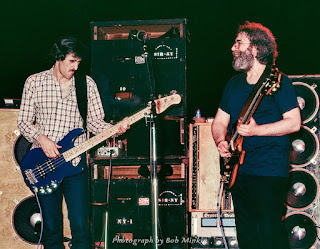
during “Scarlet Begonias,” song eight of the opening set. Lesh’s bubbling bass
provides a sturdy framework as the music aligns inside. There’s an ecstatic
aura gushing throughout every aspect of this performance. The jam’s launched,
and Jerry’s feeling all the bumpers and always playing clean because he plays
by intuition. At one point, it sounds like “Begonias” is searching for a dance
partner, but since “Fire on the Mountain” wasn’t available yet, Garcia carries
on with a series of butter-hits-frying-pan runs. This is a stunning rendition
that I’d rank as the second-best standalone “Begonias” behind the one that
ended the first set in the Winterland on 3-20-77.
The Holy Mojo’s
rollin’ and there’s no way to slow the locomotive down. Sparks fly throughout
Lazy Lightning > Supplication. There are two meaty solos as “Sugaree” steps
into the role of set-closer. “Sugaree” seemed to grow with each performance in
’76 on its way to becoming an epic blockbuster by May ’77.
As the Dead tune
after intermission, Weir announces, “You know what? Well, Bill (Graham) says we
only got an hour from when we start playing, so we’re not gonna start playing
for a little bit.” Their hour begins
with “St. Stephen,” and ends two hours later with a double encore. Neither
intermission nor allotted time slots could derail the Dead Express on this
night. Bill and Mickey are locked in tight as St. Stephen > Not Fade Away
rocks. The shadow of The Who waiting in the wings seemed to inspire this
thunderous output. The Who’s extraordinary bassist, John Entwistle, was
celebrating his thirty-second birthday on this day by The Bay.

Following Donna and
Bobby’s “NFA” chant, a smooth chord vamp leads back into “St. Stephen.” “St.
Stephen” lands with its Q & A finale: “Can you answer? Yes I can! But what
would be the answer to the answer man?” A suspenseful second of silence is glorified
by the bouncing beat of Garcia’s guitar proclaiming the arrival of “Help on the
Way.” It’s an exhilarating handoff: the past, Aoxomoxoa, shakes hands with the future, Blues for Allah—Paradise
waits, like a crest of an angel in flames.
Garcia’s guitar twangs pierce through the
Oakland Coliseum like the sound of a marching brass band on Benzedrine during “Help
on the Way.” Masters of their domain, the musicians blaze forth—a unified
psychedelic stand. A subtle “Slipknot!” slowly and sweetly spins into a drum
solo that introduces “Samson and Delilah.” This gorgeous loop finds its way
back home with the resurrection of “Slipknot!”
The Slipknot! > Franklin’s Tower bridge is
crafted patiently and precisely—one more tantalizing segue to the last number
of the loop. And what a grand finish to the set “Franklin’s Tower” provides.
Each solo is an opportunity for Jerry to paint, and he fills the canvas until
the masterpiece is complete.
The fire and fury of 10-9-76 is also evident
in the double encore. “One More Saturday Night” features superb vocals from
Bobby and Donna. There’s tangible enthusiasm during “U.S. Blues” as the Dead
get a final chance to reward their fans and impress those who came to see The
Who. Garcia doubles down and extends his final smoking guitar solo of the
night. This wasn’t a major event like Woodstock, but this was another
performance that debunked the myth that the Dead failed to rise to the occasion
on the big stage. On this afternoon in the Oakland Coliseum, they were Rock
Gods beyond expectation.
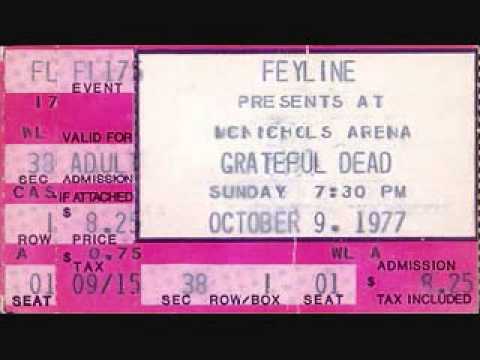
By the time the band arrived in Denver’s McNichols
Sports Arena the following year on October 9, 1977, the Grateful Dead had had
one of their most sensational touring runs, highlighted by their legendary
performances in Cornell and Englishtown. The first set of 10-9-77 explodes
towards the end with desirable tune selection almost identical to what they had
played the year before in Oakland if you switch out “Scarlet Begonias” for
“Music Never Stopped.” Demonic energy crackles throughout this Denver show.
Maybe it could be chalked up to the mile-high atmospheric conditions. Legendary
archivist Dick Latvala brought fame to the band’s next performance in Norman,
Oklahoma, on 10-11-77, calling it one of the three examples of primal Dead. I’m
not sure what criteria I would use if someone asked me to list three shows that
embody the concept of primal Dead, but I believe this Denver show is more primal
than the one in Norman. One fact is undeniable: the band was ferocious during
the second week of October 1977.
Lazy Lightning > Supplication vibrates from
a bombardment of compressed high-frequency sounds that gets the Dead into that
strange terrain that only they can navigate. Garcia’s guitar has a shrill,
glistened tone as he explores “Sugaree.” Solo two disdains civility as they rock
Denver with scary, spine-tingling stuff—the Dead tap into the dark side of
their collective past, unleashing unknown demons—a group exorcism. There’s
nothing left in the tank for the third jam, but this is a lofty “Sugaree,” the
finest one ever performed in the Rockies.

The rabble-rousing
set comes to a kinetic conclusion with “The Music Never Stopped.” Jerry’s
build-up jam sears and soars, and all hell breaks loose when the band turns it
over. Garcia’s picking and strumming fast and furious, a half-step ahead of his
mates who are hammering away in unison. Garcia redirects the jam as the tempo
continues to accelerate. It’s a test of wills. Can Garcia stay a stride ahead
of the band, and can the band keep up the pace? The answers are yes and yes as
the music thunders. Phil had to be jumping in the air as he pounds away in time
with Billy and Mickey. The Dead are in savage mode, and they take this “Music”
for a ride on the wild side. This is right up there with the best “Musics” of
’77: 5-9 Buffalo, 5-18 Atlanta, and 10-1 Portland.
“Samson,” Scarlet
> Fire keeps the engines burning at the start of set two. Don’t miss the
superb “Fire” outro. The rest of the show trails off into obscurity. However,
the muscular output discussed here makes 10-9-77 a distinctive, must-listen performance.
The first of fourteen Grateful Dead concerts
in the picturesque Frost Amphitheater on the campus of Stanford University took
place on October 9, 1982. The band shakes off the cobwebs with Alabama Getaway
> Greatest Story Ever Told. The rest of the set is pure bliss—an intoxicating
punch of ’82 fluidity and crispness. Weir sandwiches two lively combinations
around a fluid “West L.A. Fadeaway.” A thrilling romp through “On the Road
Again” leads neatly into “Beat it on Down the Line.” After singing the opening
line, “Well this job I got is just a little too hard,” Weir adlibs, “Just like
a Swiss watch.” This is a wonderful combination that has me wishing the Dead
played “On the Road Again” more often. After the acoustic Radio City sets,
twelve electric versions of “On the Road Again” were performed between ’81 and
’84. An electric “On the Road Again” always seemed to indicate that the Dead
were in good spirits and in the thick of crafting exciting music. The Me and My
Uncle > Big River that follows “West L.A.” is a ripper.

“Dupree’s Diamond Blues” in the ninth spot of
the set is simply the best. From Garcia’s angelic voice and sparkling solos to
the band’s timing, the 10-9-82 “Dupree’s” is flawless. Hunter’s clever “Don’t
bring your gun to town” tale comes across vividly in 3-D. Jelly roll will drive
you stone mad indeed. The danceable groove and the squeaky/slick tone of
Jerry’s leads are irresistible. The Dead successfully breathed new life into
“Crazy Fingers” and “Dupree’s Diamond Blues” in ’82.
“Music Never Stopped” keeps the fire burning
on the heels of “Dupree’s.” There’s no hesitation or stumbling in any aspect of
the playing as they streak through “Music.” Garcia drops it into overdrive from
the building jam until the journey triumphantly runs its course. Jerry wants more,
and instead of tacking on “Don’t Ease Me In,” he breaks into “Deal.” Whenever
there’s a “Deal” after “Let it Grow” or “Music Never Stopped,” it means the
band’s all in to win. They blitz through “Deal,” closing this presentation in
thrilling fashion.
Set two opens with a smooth pairing of new
tunes, Throwing Stones > Touch of Grey. For the most part, the kinks in
these original compositions have been straightened out. The band moves on by
falling back on the familiar Estimated > Eyes combo. There’s a pleasant pace
to “Eyes” as another enjoyable but unremarkable version goes into the archives.
Truckin’ > The Other One > Morning Dew
> One More Saturday Night provides a delectable finale for those on hand for
the Dead’s Frost Amphitheatre debut. There’s a nice between-verse “Other One”
jam, and “Morning Dew” is inspired all the way through and is the best of the
eight “Dews” played in ’82. Many songs excelled with the ’82 style, but most
versions of Scarlet > Fire, Estimated > Eyes, and “Morning Dew” lacked
extensive jamming. I don’t think anyone in the Frost pondered the lack of
anything on 10-9-82. This is a glowing performance, spectacular at times, and
always engaging.
For more on the other outstanding October 9 performances: 10-9-72
Winterland, 10-9-83 Greensboro, 10-9-89 Hampton, check out DEADOLOGY: THE 33ESSENTIAL DATES OF GRATEFUL DEAD HISTORY