A flawless second set containing one
of the greatest segments of music in Grateful Dead history fifty years ago
today.4/8/72 Empire Pool
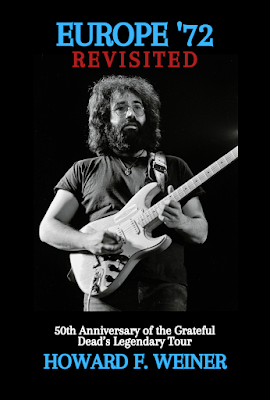
Excerpt from Europe 72 Revisited
If I could go back in time and hang
with the band during a set break, I’d pick this evening in London. I want to
know what they were smoking, drinking, ingesting, or snorting. I’d love to hear
their conversations. What music was playing in the background? Did they sense
they were on the verge of creating transcendent music, or was it just another
Merry Prankster set break, no different than the scenes in Amsterdam or Paris?
They were obviously as in-the-moment as any artists could be when set two takes
flight. But even in the most optimistic state of drug-induced euphoria, no one
backstage could have imagined that the Grateful Dead would produce a set of
music that would be revered and analyzed fifty years later, well into the next
century.
The band delivered gold with the
first three standalone performances of set two. “Truckin’,” “Big Railroad
Blues,” and “It Hurts Me Too.” Manic energy rips through “Truckin’.” The harp
and guitar give and take during the “It Hurts Me Too” jam is sacred. When Jerry
passes the baton to Pigpen, he’s bending blues-busting notes beneath his harp
blasts, and Pigpen returns the favor as his harp bleeds into Jerry’s solo.
These precision performances could have been selected for the album. There’s a
treasure trove of special music from Europe ’72, and at the top of that
mountain is what’s to follow in Empire Pool.
The boys
pounce on the opening of the first European “Dark Star.” The music’s obscene,
and it emerges like a heavenly rhapsody—possessed jamming with a séance-like
vibe envelops Empire Pool. It sounds as if they’re channeling the ancient
footsteps and spirits of Europe. Sometimes it’s what you don’t play that helps
a jam take off, and Garcia and mates steer this through a cosmic black hole and
turn through the pages of European history: Machiavelli, Shakespeare, and
Tennyson; Beethoven, Bach, and Chopin; Nero, Napoleon, and Hitler; it’s all there.
The mood is mysterious and dark, and the music’s packed with wisdom. The music
throttles mind and body—scary and beautiful.
After
the jam radiates for eleven minutes, Garcia sings, “Dark star crashes, pouring
its light into ashes.” London’s casually ripped out of their comfort zone, or
to quote Dylan, “This sky, too, is folding under you.” The band continues their
individual forays into the unknown, yet there’s an invisible force pulling
everything together. There’s a knowing flow to this unconducted symphony. Maybe
the band needed to leave America to get out of their comfort zone and step
their artistry to its highest possible ground.
Jerry’s a beast towards the end of
this “Dark Star.” As the band suggests “Sugar Magnolia,” they slip into segue
paradise—the borders between “Dark Star” and “Sugar Magnolia” are erased. The
negotiation between the two Dead anthems is enthralling. All the uplifting
powers of spontaneous improvisation shine brightly. This transition between
songs is orgasmic—four riveting minutes of indigenous Grateful Dead jamming.
“Sugar Magnolia” is an ideal landing
tune for a deep “Dark Star” voyage—Southern love and sunshine daydream—a
blissful rocker. Mind leaves body, and now body defies gravity as the audience
bounces and shakes to the groove. The Dead rock this hard, yet it seems like
child’s play after the radiant sophistication of “Dark Star.” “Sugar Mag”
dazzles with a more than adequate jam, and the Sunshine Daydream coda rams into
“Caution (Do Not Stop on the Tracks).”
“Caution” was only played once in
1971. It’s one of the early Dead classics that had been bumped from the
rotation due to the influx of originals. Thankfully, it was revived for what
would be Pigpen’s final tour. The 4-8-72 performance is a seventeen-minute
blitzkrieg, yet it’s a smoother ride than the rambunctious “Cautions” of days
past.
After the opening stampede, Pigpen’s
voice howls through Empire Pool, “All you need, all you need!” Smooth organ
playing mingles with Jerry’s noodling to the next segment. After a brief stop,
Ron’s at the mic again and he’s firing up England: “Do you feel all right? I
can’t hear you. Do you feel all right? Just a little bit louder. LOUUUDERRRR!”
Phil blasts the rhythmic pattern again and Jerry’s on the move. Pig grabs a
harmonica and blows as Jerry pokes and pecks with him. Phil revs up the theme
again and the band moves to what appears to be Feedback, but persistent Phil
hits the signature “Caution” line again and Jerry goes berserk. The band
unloads as they ride this monster down the homestretch. After the final blow,
Sam Cutler grabs a mic and hollers, “Grateful Dead!”
“One More Saturday Night” is the
encore. On the surface this may not seem like a thrilling development, but on
this evening, it’s insanely satisfying. Feeling triumphant after an outrageous
set of music, Weir and the band rock this little ditty as if their legacy
depends upon this one performance. Bobby’s howling and saliva’s flying. Leading
to the final singalong, he advises the band: “Easy now,” and then, “Wail away!”
Keith and Billy heed his advice and hammer the groove. “One More Saturday
Night” can’t rage any harder. The fact that it actually was Saturday night aided
the urgency of this rendition. There are few four-song conclusions that dare to
compare to what the Dead pulled off in London on 4-8-72.
PREVIEW EUROPE 72