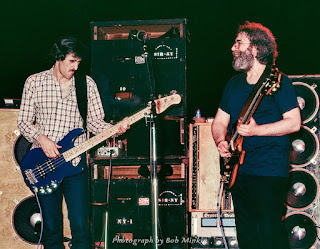
For obvious reasons, December 31 is one of the essential dates of Deadology.
Bob
Weir and friends were passing by Dana Morgan’s music shop on New Year’s Eve
1963 when they were drawn to the sound of banjo picking. They entered the shop
and one of Bob’s companions knew the banjo player, Jerry Garcia. The noodling
musician mentioned that he was waiting for some students to show for lessons,
although he was quite content to be playing by himself. Weir and friends found
some instruments and had an impromptu jam with Jerry. They discussed forming a
jug band, and shortly thereafter, Weir, Garcia, and Pigpen were performing as Mother
McCree’s Uptown Jug Champions. In Garcia’s wildest thoughts, he never could
have imagined that he’d be performing live music with Weir almost every New
Year’s Eve for the rest of his life.
In addition to all the extraordinary
music created by the Grateful Dead on New Year’s Eve, this is easily the
best-documented day. The band played twenty-two times on this date, out of
which there are twenty existing audio recordings, and many of these shows were
filmed and can be viewed on YouTube. These year-end celebrations, often
three-set affairs, gave the band an opportunity to deviate from the unofficial
rules of how a show was constructed in the Grateful Dead Universe. If you add
in the eclectic mix of guest musicians and celebrities joining the band on
stage, then one could write a book solely on the Grateful Dead’s New Year’s Eve
exploits.
Most critical studies of a band’s archive
focus on years or an era chronologically—a horizontal approach. Deadology takes a vertical approach as
all the Dead’s years combined are studied through the lens of a single date.
These thirty-three essential dates are unique mini-histories of a band beyond
description. On their own, a compilation from any one of these essential dates
can produce a box set of music that could stand toe-to-toe with the excellent
So Many Roads (1965-1995) box set.
The Grateful Dead are uniquely
suited for this type of study. What musicians, artists, entertainers, or
athletes can be examined like this? One could write about the essential dates
of Bob Dylan’s career, but that endeavor would be focused on the times we wrote
his iconic anthems and alnums. The Grateful Dead experience is communal. If a you’ve
ever seen the Dead on Halloween or July 4, you were part of a larger musical tradition
tied to that day. Out of band members, Bobby, Billy, and Mickey’s birthdays
earned their place amongst the essential dates. The minimum requirement for essential
dates consideration was a minimum of three extraordinary shows on that day.
Most dates in Deadology easily
exceeded that threshold.
Before selecting
the entries for Deadology, I guessed
the month with the most essential dates would have been April, or perhaps May.
Surprisingly, October topped all other months, with eight essential dates.
Here’s the breakdown: October (8), September (6), April (5), July (4), May (3),
June (2), February (2), November (1), March (1), December (1).
Here are the 33
Essential Dates:
February 17, February 28, March 23, April 6, April 8, April 12, April 21, April 22, May 5, May 7, May 11, June 16, June 24, June 30, July 2, July 4, July 10, July 18, September 2, September3, September 11, September 18, September 21, September 23, October 9, October 12, October 15,
October 16, October 17, October 19,, October 20, October 31, November 17, December 31
As Garcia, Saunders, Kahn, and
Kreutzmann launch “It Takes a Lot to Laugh, It Takes a Train to Cry,” time’s
suspended by the hypnotic groove. It’s a Dylan tune, yet there are no lyrics to
ponder. The repetitive riff is sublime—Frisco Blues—as mysterious and vast as
the Pacific, yet heavenly and cool in the style of Miles. Garcia’s snapping
strings sing a lonely lullaby—poetry-in motion. The drummer and bassist are
locked in tight, and the beat bounces brightly as the earthy vibrations of the
Hammond organ swirl in and out and all around—aural ecstasy! This blues riff
will never sound this good again, and the musicians know IT. There’s a song to
be sung, somewhere down the line, but the band proceeds deliberately, intent on
basking in the moment. A modest studio gathering and a privileged West Coast FM
radio audience are listening in on this intimate musical conversation. Out of
the mesmerizing groove, a mellifluous voice suddenly whispers:
“KSAN in San Francisco.”
Ordinarily this type of interruption
would defile a masterpiece like a scar on the Mona Lisa, but the lady DJ sounds
sultry, and it seamlessly intertwines with the music as if it were preordained.
And if ever a radio station deserved to beat their chest, KSAN deserved props for
broadcasting this jam from Pacific High Studios on 60 Brady Street in San Francisco.
The musicians in the studio couldn’t hear the radio call letters, but Garcia is
seemingly spurred on as if he could hear the DJ’s titillating tones. With each
round, his leads become more pronounced and provocative. Garcia’s obviously an
inspired man, possibly possessed. Even the purest of archivists wouldn’t wish away
the KSAN interruption. It’s a stamp of immortality.
Jerry
draws a deep breath, steps to the mic, and an angelic voice fills the air.
“Wintertime’s coming, it’s filled with frost. I tried to tell everybody but I
could not get across.”
Hey,
Jerry, wrong verse…wrong lyrics! Garcia sings the third verse instead of the
first, and Dylan’s words are, “THE WINDOWS are filled with frost.” Yet we’ll
forgive this faux pas because the bearded guru is singing with feeling, sweet
and true. Without a trademark solo, Jerry transitions from the third verse to
the first:
“I
ride a mail train, mama, can’t buy a thrill.” Priceless. Garcia caresses every
syllable until the jingle nimbly touches down. Garcia will perform more complex
versions of “It Takes a Lot to Laugh, It Takes a Train to Cry,” but few satisfy
like this odd nugget which radiates in its own imperfection. If I were
commissioned to arrange a soundtrack for a documentary on the essence of Garcia
as a performer, this is where it would begin.
The band noodles and doodles in
preparation for the next entrée. Garcia has a thing for tuning up. It’s an
artistic endeavor for him, and quite frankly, the guy’s got a problem; he can’t
stop picking. Someone in the pocket-sized audience yells out a barely audible
request, and Garcia replies, “Everything’s gonna be all right.” Sure, that was
easy for Mr. Garcia to say. By 1972, he had the hip world at his command. With
the Grateful Dead’s most recent vinyl releases, Workingman’s Dead
(recorded in Pacific High Studios) and American Beauty, the
band had finally tasted commercial success and critical acclaim. The band’s
lyricist, Robert Hunter, was on the mother of all rolls, penning verse after
verse, and anthem after anthem, as if he were Robert Allen Zimmerman, the pen
master himself. And the twenty-nine-year-old leader of the band, Jerry Garcia,
was a virtuoso in his prime, unleashing visions and dreams beyond imagination.
With Kahn, Kreutzmann, and Saunders jamming by his side, Garcia glowed.
Everything’s gonna be all right, indeed.
Following Garcia’s proclamation, the band
slams into “Expressway To Your Heart.” All aboard the Motown Express! This
little ditty penned by Gamble and Huff, and made famous by The Soul Survivors,
is now a vehicle bulleting at the speed of sound—a bawdy traveling companion
for “It Takes a Train to Cry.” Garcia and friends hammer “Expressway” as if
this is the last jam of humanity. This tour de force rages down a jagged
highway, and the band never eases off the gas—ten minutes of thrills at
breakneck speeds. They interact as if they’ve sped down this road a thousand
times before; however, this is their debut gig as a quartet. Jerry defers to
Merl a few times, and Saunders drains a whole lotta soul from his Hammond B-3
organ. But on this number, Garcia’s driving the train, and it’s quite possible
he’s high on cocaine. His volatile playing veers off the tracks, yet the
Bearded One finds his way back home by balancing musical equations on the fly.
For
this Pacific High gig, Grateful Dead drummer Billy Kreutzmann, fills in for Bill
Vitt, who had handled drumming duties for most of the Garcia/ Saunders shows.
The familiarity of having Kreutzmann striking the skins is a rallying force for
Garcia, and it energizes the quartet as a whole. The first Garcia/Saunders show
took place on December 15, 1970, and after twenty or so performances, Garcia
and Saunders were bubbling like lava. Jerry had also been moonlighting with the
New Riders of the Purple Sage, but this involvement with Saunders and Kahn had
developed into his pet project outside of the Grateful Dead. With Kreutzmann on
board, this was perhaps the finest band of Bay Area musicians ever assembled.
These visionaries were on the same wavelength, speaking the same language; yet
there was virginal excitement in Pacific High Studios—a talented group hitting
it off on their first date.
On
the heels of such a fanciful Pacific High opening, “That’s a Touch I Like” is
no slouch in the third slot; in fact, it’s ravishing. After a crisp opening
solo, Jerry croons, “Red ribbons in your hair, I’m kind of glad that you put
them there. That’s the touch I like. That’s the touch I like. Whoa-oh-oh,
that’s the touch I like.” This snippet of female infatuation was penned by
Jesse Winchester for his eponymous 1970 album. On that record, this tune is mislabeled
as “That’s the Touch I Like,” and
that’s the touch Garcia likes, because that’s the way he sings it. Winchester
actually sang, “That’s a touch I
like,” and when his album was reissued on CD in 2006, the title was corrected.
Anyway,
those witnesses at 60 Brady Street must have been swept out of their seats. Garcia’s
charm and inquisitive nature took center stage. Is it the red ribbon, or the woman,
that sparks the singer’s imagination? Either way, Jerry’s so pleased, he
concedes, “I’ll be on my very best behavior.” The pulse and vibration of this
performance is infectious, an instant remedy for the blues.
In
arcane ways, these songs seem to be communicating with each other; each tune
has a companion. It begins with the traveling tunes, “Train to Cry” and
“Expressway.” The flipside for “That’s a Touch I Like” is this show’s encore,
“How Sweet It Is.” Written by the team of Holland-Dozier-Holland, and popularized
by both Marvin Gaye and James Taylor. “How Sweet It Is” would go on to be
immortalized by the Jerry Garcia Band, becoming their signature opener, and the
band’s most frequently played number. In substance and style, “How Sweet It Is”
and “That’s a Touch I Like” are siblings; yet, “That’s a Touch I Like” would
never be performed again after May 21, 1975. Of the two, I prefer Jesse
Winchester’s baby. It could have been a dynamite alternative opener to the
overplayed “How Sweet It Is.” However, on this night, both ballads are
rapturous, a snapshot of Jerry’s giddy optimism.
These
were also optimistic times for American culture. In February of 1972, two
cinematic classics, The Godfather
and Deliverance, were released, and Don
Mclean’s “American Pie” was number one on the Billboard charts. In matters of
war and peace, these were turbulent times. The United States was fatigued from
a decade of civil strife and the horror of the never-ending war in Vietnam.
Moving songs of protest, empowerment, and hope were replaced by monumental
escapist anthems and Teflon rock. Maybe music couldn’t change the world, but it
could take you to another time and place—transcendence. And in 1972, nobody was
improvising mind-bending guitar jams like Jerome John Garcia.
Back
in Pacific High Studios, Kahn kicks off “Save Mother Earth” with thick,
brooding bass blasts. Soulful riffs from Saunders ensue, and Garcia answers
with yearning guitar bursts. The only original played by the band on this
night, “Save Mother Earth” was written by Saunders for his soon-to-be-released
album, Heavy Turbulence, which would also
feature the following number, “Imagine.”
Garcia
must be donning Superman’s cape as he wails on “Save Mother Earth.” Captain
Trips breaks the instrumental free from the mother ship, spinning and spiraling
it to the cosmos and beyond—“Dark Star” > “Mind Left Body Jam” territory,
the psychedelic providence of the Grateful Dead. Jerry pecks away frantically
and the sonic voyage gets way out there—farther, further, faster. When the
exploration crackles, fizzles and fades, Saunders gently leads the band into
“Imagine.” The audience applauds the soothing familiarity of the melody, relieved
to be floating back towards earth. The segue is flawless. There’s no attempt to
sing Lennon’s song. Garcia’s guitar humbly and simply pleads for peace on
earth.
For
Deadheads who collected bootlegs prior to the proliferation of digitized music,
“Imagine” is the last song on the first side of a ninety-minute Maxell XLII
cassette tape. The tape from 2-6-72 is a perfectly balanced boot that plays
like an album. Sides A and B have their own distinctive mojo, and they
complement each other as if they are separate sets, although this is a
ninety-minute performance with no break. As the most bootlegged performer of
his time, Garcia seemingly had a sixth sense for filling up tapes, as if he was
performing especially for the tapers. This notion is not farfetched. In the
early ‘60s, Garcia bootlegged largely unknown and wildly talented bluegrass
musicians—the very troubadours that fueled Garcia’s
guitar picking fetish.
Side
B commences with “That’s All right Mama,” a four-solo pressure cooker—Beale
Street spirit meets New York City tenacity. Rolling Stone magazine
identified Elvis Presley’s recording of “That’s All right Mama” as the first
rock and roll record, and Garcia’s extended version embdies and amplifies that
rowdy/rebellious swagger. “One and one is two. Two and two is four,” sings
Jerry. Improvisation is like arithmetic in Garcia’s brain. The waterfall of
creativity flows from his guitar, yet it all makes sense; every note is a
number leading to the final sum. Transparency. When Garcia’s in the zone, he’s
like Einstein on bennies—in front of a blackboard, chalk in hand.
Lingering
in the Mississippi Delta, the band pairs “That’s All Right Mama” with Jimmie
Rodgers’ “That’s All Right,” a song that has been mislabeled on most Pacific
High Studio tapes as “Who’s Loving You Tonight.” The circulating KSAN tape is
missing the opening of this song and it’s a damned shame, because as we jump
in, Garcia’s on a rampage; his searing leads sizzle in agony. Saunders leans
into his Hammond and unleashes hissing, hell-bent blues, the nasty and
tenacious strain. As Jerry follows, he comes off like Clapton, Bloomfield, and
Stills all rolled into one, and as he finishes out this tribute he howls, “But
now that I wonder, whoo-ooh-ooh-ohh’s loving you tonight.” Somewhere in heaven,
Jimmie Rodgers yodels back his approval.
An
iconic album, or performance, is usually characterized by a magnificently
orchestrated selection of songs that relate to, and build upon, each other, so
that the listener is drawn deeper into the web of the artist’s vision. If you
hit a shuffle button and randomly listen to the songs of Abbey
Road,
the playback won’t create the same experience as if the songs were heard in
their rightful order, as consciously conceived by The Beatles and George
Martin. The songs still stand on their own, but their collective power
diminishes. Great live performances can be consciously orchestrated, but I
prefer the thrill of free-flowing improvisational genius, which under the right
circumstances, and fueled by the right momentum, can create a masterpiece that
exceeds what the performer or audience could have ever imagined. On 2-6-72,
Garcia is in that rarified air. After the Jimmie Rodgers’ stomp, Garcia paints
his masterpiece with Dylan’s “When I Paint My Masterpiece.”
“Oh,
the streets of Rome are filled with rubble, ancient footprints are everywhere,”
croons Garcia—admiration and awe blatant in his delivery. In Garcia’s world,
Dylan’s visions are glorified: Inside The Coliseum, dodging lions
and wasting time…I landed in Brussels, on a plane ride so bumpy that I almost
cried…Train wheels running through the back of my memory…Young men in uniform
and young girls pulling mussels…Newspaper man eating candy, had to be held back
by big police. Oh, the sights and sounds! In Dylan’s
studio recording of “When I Paint My Masterpiece,” the kaleidoscope of images
are stacked upon each other, almost too much to ponder in a single listen. In
Garcia’s “Masterpiece,” the tempo is relaxed, and the tone of his vivacious
vocals illuminates Dylan’s lyrics. The three wicked guitar solos give the
listener the time and space needed to relish and absorb the majesty of it all.
Just
as the show had begun with a Dylan/Motown one-two wallop, Garcia and his
cohorts chase “When I Paint My Masterpiece” with Stevie Wonder’s Motown
masterpiece, “I Was Made To Love Her.” Like “Expressway To Your Heart,”
Wonder’s genius is transformed into a colossal instrumental. The symmetry of
this concert is uncanny. One and one is two. Two and two is four.
On “Expressway,” the band latches onto a tight groove before Garcia comes off,
but on Wonder’s tune, Garcia’s en fuego
from the get-go. Graciously, Jerry defers to Merl, and the funky organ grinder
swamps the studio with R&B. Kahn and Kreutzmann crank the tempo, imploring
Garcia and Saunders to take it beyond their comfort zone. Like Ali in his
prime, Garcia’s creative flow is endless. There’s never a dull moment, aborted
lead, or hesitation of any kind.
Amazingly,
this was Garcia’s debut of “I Was Made to Love Her,” an instrumental he would
only perform six times, and never again after 1974. All of this experimentation
by Garcia was stunning considering what a groundbreaking year 1972 would be for
the Grateful Dead. After a short run of shows at Manhattan’s Academy of Music
in March, the Dead barnstormed Europe for six weeks, which led to the
idiosyncratic triple album, Europe ’72,
which once again showcased the mystical musings of Robert Hunter. On a
100-degree day in August, the Grateful Dead melted minds with a three-set spectacular
on Ken Kesey’s farm in Oregon. The band’s fall tour was even hotter; but all of
this was not enough for Garcia. He was driven to explore and pay homage to the
music he cherished. And this band he formed with Saunders and Kahn completed
Garcia as an artist. The music would never stop.
The
jam on 2-6-72 doesn’t need an exclamation point, but Garcia provides the
punctuation with Doc Pomus’ “Lonely Avenue.” Once again, the song symmetry is
there—a Stevie Wonder number is followed by a tune that his mentor, Ray
Charles, made famous. “Lonely Avenue” also pairs off well with the earlier
blues scorcher, “That’s All Right.” Here’s to the slipstreams of imagination
that flow through a gifted mind.
During
the melancholy intro, Garcia’s guitar weeps: “I could cry, I could cry, I could
cry…I could die, I could die, I could die. I live on a lonely avenue.” Tears
fill each syllable as Jerry belts out, “My room has got windows and the
sunshine never comes through.” And the way he achingly sings, “I live on a
Looonleyyyy Ave-ah-nue…” It’s pure heartache—the blues minus humor, irony, or
defiance. Garcia’s voice calls, and his guitar responds patiently to his own
pleas.
Garcia
lived on the same Lonely Avenue as Doc Pomus and Ray Charles. These musical
brothers are bonded by the pain of suffering through unspeakable childhood
tragedies. Jerry Felder, who later changed his name to Doc Pomus, was crippled
by polio at a young age. Ray Charles Robinson completely lost his eyesight when
he was seven, but prior to that, he witnessed the drowning of his brother
George in a laundry tub, a vision that would forever haunt him. When Garcia was
five, he may have witnessed the drowning death of his father Jose on a fishing
trip. It isn’t clear whether Jerry actually saw the drowning, or if it became a
learned memory from him hearing the story retold; but either way, the pain of
losing his father was unbearable. A year earlier, Jerry had two-thirds of the
middle finger on his right hand severed as he was steadying wood for his older
brother, Tiff. Yes, five-year-old Tiff was swinging the axe that accidentally
severed Jerry’s finger. Doc, Ray, and Jerry were all too familiar with growing
up on Lonely Avenue .
In
the heat of this Pacific High “Lonely Avenue,” Garcia bends his guitar strings
until they screech and scratch with all the surpassed pain of his childhood
during the solos, most notably, the second one. The sky’s a-crying as Garcia
methodically plots his attack and unloads it with the fervor of a preacher
prognosticating the apocalypse. Kahn’s a demon, thumping with all the madness
in his slender frame, prodding Garcia past the point of no return. Climaxing
with a mandolin-like tremolo, Garcia kicks on the wah-wah pedal to infuse some
final despair. Clearly Garcia is a learned disciple of the blues tradition.
This cathartic journey is bound to rattle your bones and shock your brain.
“How
Sweet It Is” wraps things up; but after “Lonely Avenue” it’s anticlimactic,
like watching a battle for bronze. In a rousing ninety-minute romp, Pacific
High radiates the talents of Garcia better than any studio release of the
Grateful Dead or Jerry Garcia Band. Beyond any shadow of doubt, 2-6-72 features
the finest renditions of “Expressway To Your Heart,” “That’s a Touch I Like,”
“Save Mother Earth,” “I Was Made to Love Her,” and “Lonely Avenue.” It’s a
rolling rhapsody of masterpieces in their early prime, raging in all their
glory.
In
one impromptu performance, Garcia and mates assembled and reinterpreted an
anthology of Americana that covered a vast spectrum of musical genres linking
legendary lyricists and performers: Dylan, Lennon, Wonder, Charles, Presley,
Pomus, Rodgers, Gaye, Saunders, Winchester, Holland-Dozier-Holland, Gamble and
Huff. Although Lennon hails from the foreign shores of Liverpool, “Imagine”
became an American lullaby, a melody of hope for a burned-out nation. If one
were to arrange the originals of these songs for an album, the sum would be the
embodiment of essential Americana, perhaps the beginning of a modern companion
for Harry Smith’s extraordinary Anthology of American Folk Music
(1952).
Pacific
High has gone on to become a consecrated recording for Garcia aficionados, and
because it has yet to be officially released, it maintains the alluring appeal
of a bootleg. With the plethora of officially released Jerry Garcia Band
concerts, I can’t fathom why 2-6-72 hasn’t met the same fate. Possibly some
bootlegs are too hot for public consumption; they’re destined to remain in the
Bootleg Zone, where only true fanatics can access, trade and obsess over them.
This
rambunctious Pacific High jam was a crossroads performance for Garcia who,
against his will, had been anointed as the inspirational guru of the
Haight-Ashbury scene, just as Dylan had been anointed as the voice of his
generation. Dylan’s radical break from the folk scene came when he donned a
black leather jacket, strapped on an electric guitar, and blasted away the
peaceful expectations of those at the 1965 Newport Folk Festival with a
performance that was as outrageous as it was courageous. He temporally riled up
a few folkies, but more significantly, he turned on and influenced a budding
generation of rockers, including the Beatles, The Byrds, Jimi Hendrix, and the
Grateful Dead.
Critics
and fans have always tried to stamp and label Dylan, but as a solo performer
with a lot of nerve, Dylan has remained elusive, dodging other’s expectations.
On the other hand, Garcia was always trapped by the expectations of his rabid
fan base and those in the extended Grateful Dead family who depended on him for
their own livelihoods. Garcia could never pull off a Dylan and completely
reinvent himself. It’s well known that Jerry didn’t have a confrontational bone
in his body. Captain Trips never desired the leadership role in the Grateful
Dead, but sometimes history just crowns its heroes.
As
the years rolled by, Garcia would be worshipped by millions. He could never
file for divorce from the Grateful Dead, or his hippie kingdom. To cope with
this burden, Jerry escaped into a ceaseless assortment of chemical cocktails;
but his true love was creating and performing. With Merl Saunders and John
Kahn, Garcia formed the nucleus of a band that would sustain him—a shelter from
the storm. He found a musical outlet outside of the Grateful Dead without
raising any eyebrows or alienating followers. In fact, Deadheads loved and
embraced his new band; it was a natural extension of his artistic vision. And
this performance in Pacific High Studios was a signpost to the future. The
Jerry Garcia Band was busy being born, and it would never fade away.
Inspired to return to public service
and perform his songs, Dylan unexpectedly put a pause on his plans due to a freak
accident that injured his hand. “It had been ripped and mangled to the bone and
was still in the acute state—it didn’t even feel like it was mine,” Dylan wrote
in Chronicles. “It was like a black leopard
had torn into my tattered flesh. It was plenty sore. After being on the threshold
of something bold, innovative and adventurous, I was now on the threshold of nothing,
ruined.”
Dylan wrote that the injury happened
in 1987, and talked of being laid up in January, disappointed that his ensuing spring
tour might be canceled. It’s obvious he’s talking about the 1988 tour, but surrounded
by a legendary cast, he played guitar and sang “Like a Rolling Stone” when he was
inducted into the Rock and Roll Hall of Fame on January 20, 1988. The accident might
have happened after that ceremony, because there’s no record of any public appearances
or recording sessions between January 20 and his Traveling Wilburys rendezvous in
April. It’s an unusual period of inactivity for a restless soul. Regardless of whether
the accident was before or after January 20, it was during this period of recovery
that Dylan started writing again, and these terrific songs would end up on his next
album, Oh Mercy.
Among those inducted into the Rock and
Roll Hall of Fame with Dylan were the Beatles, Beach Boys, Woody Guthrie, Lead Belly,
and Les Paul. One of the memorable moments was Bruce Springsteen’s induction speech
for Dylan. Bruce said, “When I was fifteen and I heard ‘Like a Rolling Stone,’ I
knew that I was listening to the toughest voice that I had ever heard…a guy that
had taken on the whole world and make me feel like I had to, too. The way Elvis
freed your body, Bob freed your mind.” Paying homage to Dylan’s latest works, Springsteen
added, “To this day, where great rock music is being made, there is the shadow of
Bob Dylan over and over again…If there was a young guy out there writing ‘Sweetheart
Like You,’ writing the Empire Burlesque
album, writing ‘Every Grain of Sand.’ they’d be calling him the new Bob Dylan.”
It was a thorough induction speech hitting all the right notes, putting Dylan on
Mount Rushmore without putting him out to pasture.
Dylan couldn’t have fathomed that after
paying his dues for twenty-six years on the road to the Rock and Roll Hall of Fame,
he hadn’t even reached the halfway point of his career. He would go on to play more
shows in the second half of his career than the Grateful Dead did during their Long
Strange Trip from 1965-1995. Of course, this was a silly and implausible notion
for anyone to ponder back in 1988, but the new Dylan was on the cusp of a remarkable
rebirth.
Jerry Garcia never changed masks. Year
after year, it was the same musicians by his side and the same tie-dyed masses out
there, getting larger and larger and becoming more supportive. It didn’t matter
anymore how good the band was playing; everything was groovy and greeted with rapturous
applause. Commenting on the crowds at the shows he was doing with Petty, Dylan said,
“I’d see people in the crowd and they’d look like cutouts from a shooting gallery,
there was no connection to them.” In March of 1988, as I heard Deadheads explode
in ecstasy to mediocre music, I felt little connection to the scene. I wondered
if Garcia felt the same way as Dylan did on certain nights, as if he was playing
for spinning hippie puppets.
The
Dead’s spring tour of ’88 had few shows that impressed me. At this point I was satisfied
with a couple of hot jams per show, something worthy of repeated listens. There
was a hot “Mississippi Half Step” in Atlanta, a killer “All Along the Watchtower”
in Hampton, and a smoking “Fire on the Mountain” at the Brendan Byrne Arena. But
after seeing three abysmal shows to end the tour in Hartford, the idea of putting
in all this effort to watch Garcia deteriorate before my eyes didn’t make sense.
The coma did take something out of Garcia’s
creativity on certain songs. The more intricate jams of “Let it Grow,” “Scarlet
Begonias,” and “China Cat Sunflower” didn’t shine as they had before. In the Jerry
Garcia Band, hard-hitting jam songs like “Let it Rock,” “After Midnight,” “Rhapsody
in Red,” and “Sugaree” were replaced by soothing spiritual numbers. Garcia had aged
physically beyond his years, and his insane workload and inability to kick his drug
dependencies guaranteed a slow and steady decline, even though the band rebounded
for some quality runs over the next two years.
As fans drifted in and out of the Dead
touring scene, an unconditional love and allegiance to the band and Garcia remained.
No matter how drugs negatively affected Garcia’s playing, Deadheads cherished the
good times, and they never ranted against the direction the band was heading. Sure,
after experiencing the Wall of Sound in ’74, there was disappointment for some in
the stripped-down sound system and the tepid jams when the Dead returned to action
in ’76, but their loyalty remained in place. Nobody shouted “Judas!” at Garcia or
angrily protested the direction of the band. It was a world unto itself that defied
the standard rules and conventions of rock and roll and it kept growing, even when
the music went through periods of stagnation and decline. It was the opposite of
Dylan’s love/hate relationship with his fans.
Physically and mentally on the mend,
Dylan was ready to roll when he received the fateful call from George Harrison,
inquiring if he could record a B side for a single in Dylan’s Point Dume home studio.
After recording “Handle with Care” with Harrison, Roy Orbison, Tom Petty, and Jeff
Lynne, the supergroup—and record executives—knew there was potential for something
special. They decided to make an album, The
Traveling Wilburys Volume 1. With Dylan’s tour starting in June, the Wilburys
decided to write and record the album in a ten-day span in May, at the home and
recording studio of Dave Stewart of the Eurythmics.
An uncanny comradery continued through
these recording sessions as five legendary singer/songwriters strummed acoustic
guitars and set up microphones and recording equipment in Dave Stewart’s kitchen.
Jim Keltner, the percussionist for these sessions who was dubbed “Buster Sidebury,”
placed microphones on the fridge and rattled the doors with his drumsticks. From
song lyrics to vocals, everyone contributed freely, although Petty admitted he was
a bit intimidated when he was auditioned for lead vocal on a song right after Roy
Orbison. There was tremendous reverence for Roy, and a giddy feeling of disbelief
that he was in the band.
Having an ex-Beatle and Roy in the room
must have put Dylan at ease—all eyes were not focused on his every gesture. Although,
George was fascinated as he watched Bob write a large chunk of “Tweeter and the
Monkey Man.” Harrison said, “The way he writes the words down, like very tiny, like
a spider’s written it, you know, you can’t hardly read it. And that’s the amazing
thing. It’s just unbelievable seeing how, how he did it.”
Being
in the company of great singers forced Dylan to be attentive to his vocal performance.
Dylan was coming off one of his roughest years as a singer; his voice was uneven,
nasally, and whiny, and it sounded like he’d rather not be singing. Instead of being
intimidated, Dylan’s voice offered a wonderfully gruff counterpoint to Orbison.
And an engaged Dylan made Petty seem like an apprentice. As consistently smooth
as Harrison and Lynne were, Orbison and Dylan are the standout voices of the Traveling
Wilburys.
Paul
Williams was an outstanding Dylan analysist, but I found his criticism of “Tweeter
and the Monkey Man” harsh: “To my taste the song that resulted is significantly
lacking in charm; and Dylan’s delivery of the narrative as lead singer is void of
presence or conviction.” I believe the opposite. The dynamic that makes this song
special is Dylan’s singing. He could have used dummy lyrics with the driving energy
and sharp cadence at play here. Even though the tune was constructed quickly, he
sang brashly, as if this were an urgent tale. “Tweeter and the Monkey Man” is a
light-hearted outlaw New Jersey adventure that includes the titles of two Springsteen
songs, “Mansion on the Hill” and “Thunder Road,” and there are allusions to Dylan
songs: You can hear them tires squeal
(“Sweetheart Like You”), and in Jersey anything’s
legal as long as you don’t get caught, which is similar to in Patterson that’s just the way things go
(“Hurricane”). Steeped in Americana, “Tweeter and the Monkey Man” is not so much
a parody of a Springsteen or Dylan song as it’s a parody of the Traveling Wilburys
and the song-making process they found so engaging. “Tweeter and the Monkey Man”
makes my double CD collection of Dylan’s best songs of the decade.
“Dirty
World,” a Prince parody with Dylan on lead vocals, follows “Handle with Care” on
the Traveling Wilburys Volume 1. Dylan
deadpans Prince in his own style with a bold and charming vocal. With its energetic
bluster, playfully overt sexuality, and the campfire singalong finale, “Dirty World”
is a zany piece of the Wilburys puzzle, but not the type of tune Dylan would bring
to life at one of his shows. “Congratulations,” the other song Dylan sings lead
on, is an outtake set of lyrics that Dylan brought with him to the sessions, and
the only song that wasn’t organically created on the spot. If Dylan was determined
to stand and get back to the place he once was, these sessions were a great workout.
There’s
a magical flow to the album, and a camaraderie that’s distinctive to this group.
These were the right musicians coming together at the right time. As they had perfectly
layered “Handle with Care” with the right voices in the right spots, they accomplished
the same effect on “Last Night,” as Orbison belted out another unforgettable bridge,
“I asked her to marry me, she smiled and pulled out a knife. ‘The party's just beginning,’
she said, ‘it’s your money or your life.’”
Prior
to “Tweeter,” the eighth track, “Margarita,” captured the joyous, freewheeling spirit
of the album—everything they threw against the wall was bound to stick. It’s a simple
’50s-style pop tune with a one-word chorus, and Dylan grumbles the main verse with
pizazz, “It was in Pittsburgh late one night. I lost my hat, got into a fight. I
rolled and tumbled till I saw the light. Went to the Big Apple, took a bite.” With
that rough voice busting in, it sounds like Dylan just stepped out of a barroom
brawl. Even in a simple throwaway tune, Dylan was on his game.
Petty
takes the lead on the feel-good finale and gives a shout-out to Jimi Hendrix, “Maybe
somewhere down the road when somebody plays, Purple Haze.” “End of the Line” took
on a haunting tone when Orbison died of a heart attack three months after the album
was released. Yet, like “Touch of Grey,” it’s a triumphant song of survival.
Well
it’s all right, even if you’re old and grey
Well
it’s all right, you still got something to say
Well
it’s all right, remember to live and let live
Well
it’s all right, the best you can do is forgive
Well
it’s all right, riding around in the breeze
Well
it’s all right, if you live the life you please
Well
it’s all right, even if the sun don’t shine
Well
it’s all right, we’re going to the end of the line
This record captures a time in the lives
of five musical legends who had paid their dues, seen some tough times, and had
just tasted the sweet smell of success or were on the threshold of something momentous.
This is the coolest pop record of its kind. An album can be simple, humorous, spontaneous,
and, one of the greatest albums of all time. This can’t be classified as a Dylan
album, and I wouldn’t dare rank it with his ten best albums, but I’d find a spot
for it in my Top 100. Like the famous Seinfeld
episode when Jerry and George pitch a show about nothing to an executive at NBC,
great music, like great TV, doesn’t have be about anything or have some important
message.

 In addition to all the extraordinary
music created by the Grateful Dead on New Year’s Eve, this is easily the
best-documented day. The band played twenty-two times on this date, out of
which there are twenty existing audio recordings, and many of these shows were
filmed and can be viewed on YouTube. These year-end celebrations, often
three-set affairs, gave the band an opportunity to deviate from the unofficial
rules of how a show was constructed in the Grateful Dead Universe. If you add
in the eclectic mix of guest musicians and celebrities joining the band on
stage, then one could write a book solely on the Grateful Dead’s New Year’s Eve
exploits.
In addition to all the extraordinary
music created by the Grateful Dead on New Year’s Eve, this is easily the
best-documented day. The band played twenty-two times on this date, out of
which there are twenty existing audio recordings, and many of these shows were
filmed and can be viewed on YouTube. These year-end celebrations, often
three-set affairs, gave the band an opportunity to deviate from the unofficial
rules of how a show was constructed in the Grateful Dead Universe. If you add
in the eclectic mix of guest musicians and celebrities joining the band on
stage, then one could write a book solely on the Grateful Dead’s New Year’s Eve
exploits.