BORN AGAIN IN THE
SWAMPS
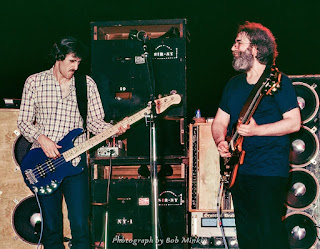
This was the third of six shows were the Grateful Dead backed Dylan on a set of his originals. The first show in Foxboro on July4, was Dylan’s first in eleven months. Combine Dylan’s sloppy and rusty performance with an off night from the Grateful Dead and the results were toxic. Show number two in JFK Stadium six nights later was a major improvement. In the moment, I was swept away by the power of seeing Garcia and Dylan on the same stage, and hearing the debut of “The Ballad of Frankie Lee and Judas Priest.” But the tape of the show is one that I’ve never been enthused about, or would recommend to impress somebody with the Dylan/ Dead collaboration. Their performance in Giants Stadium two nights later was the most consistently thrilling musical event I had ever seen, and after listening to the tapes and watching the video thousands of times over the last thirty years, I stand by that proclamation.
Hesitation and tentativeness were not an option for Dylan or Garcia. It was as if they had made a pact before the show. At the onset of the second tune, “Stuck Inside of Mobile with the Memphis Blues Again,” Dylan barked out the lyrics in garbled fashion but he never backed off, and by the third verse, the storyteller fired off the words as if he was awed by them for the first time. The Grateful Dead delivered an arrangement paced for Dylan’s style, and they left room for two concise solos. The band would add “Stuck Inside of Mobile” to their repertoire after parting ways with Dylan, and Garcia would always take two solos. On this night, after hearing Dylan passionately holler, “Oh MAMA! Can this really be the END?” Garcia adds a third solo, setting the tone for a run of heroic performances.

Garcia made the move to pedal steel as the only live Dylan/Dead performance of “Tomorrow is a Long Time” followed. The band served a lovely country-tinged rendition as Dylan grumbled and growled the lyrics as if he never heard the song before. But after singing the chorus with Garcia, Weir, and Mydland, and digging Jerry’s picking, Dylan found the emotional essence of the ballad and howled the last verse with a loving feeling.
A Tale of Twisted Fate on Amazon
Cruising along “Highway 61,” Dylan chuckled when he sang, “Found a promoter who nearly fell off the floor, yeah-eah, I never did engage in this kind of thing before, yeah-eah.” Dylan unexpectedly realized the irony of the lyrics as he was singing them, because he never did engage in this kind of thing before. Dylan was always the alpha male leading the musical charge. In Giants Stadium, the de facto leader was Garcia. In a 2006 interview for Rolling Stone with Jonathan Lethem, Dylan said, “The Dead did a lot of my songs, and we’d just take the whole arrangement because they did it better than me. Jerry Garcia could hear the song in all my bad recordings—the song that was buried there.” Garcia played a mean slide guitar during “Highway 61 Revisited.” As experimental as the Dead’s music was, Garcia was surrounded by the same musicians, with the Jerry Garcia Band as his only other musical outlet. Performing with Dylan was the fulfillment of a fantasy, and it was an opportunity for Jerry to step outside his comfort zone.

After exiting “Highway 61,” the performers attempted “It’s All Over Now, Baby Blue.” The last two times Dylan and the Dead tried this in ’86, the results were disastrous. Once again, the timing of Dylan’s singing/shouts were awkward, but he advanced confidently, and by the second verse he found a way to match his rapid-fire phrasing to the Dead’s leisurely arrangement. As Garcia sang, “And it’s all over now, baby blue,” Dylan blasted everything but the last two words, and waited for Garcia to catch up, and with the same cadence as before, hollered, “Baby Blue!” Without altering his approach, Dylan made it happen. And Garcia expressed his love of the moment with a second solo. In Grateful Dead history, this is the only “Baby Blue” with two solos, just as the earlier “Stuck Inside of Mobile” is the only one with three solos.
Something was happening as Dylan and the Dead launched “Ballad of a Thin Man,” a third consecutive foray into Dylan’s visionary mid-’60s music. There’s intense pride on the faces of Weir and Garcia as they hear Dylan deliver all the right lyrics. Garcia plays licks in response to what Dylan’s singing. The timing of all the musicians is uncanny as Brent strikes some powerful chords after Dylan blasts the “contacts among the lumberjacks” bridge. Dylan acknowledges Brent’s contribution with an emphatic, “Oh yeah!” Garcia’s exquisite, mind-melting ending solo creates a vibe of psychedelic confusion. There’s a little bit of Mr. Jones in all of us.
After the Dead help Dylan revive “John Brown,” an unreleased anti-war tale from Dylan’s early days, twilight faded into darkness as the musicians tuned-up against a background of flickering cigarette lighters. One of the massive video screens hovering over Giants Stadium lit up with the image of Garcia as his axe announced the coming of “Wicked Messenger” from John Wesley Harding, a number that Dylan had never played live. One of Garcia’s bands, Legion of Mary, covered “Wicked Messenger” a handful of times in 1975. Dylan stepped up to the mic and bellowed, “There was a wicked messenger from Eli he did come!” His visceral, preacher-like vocals matched the biblical bent of the song. If Dylan’s attentive singing was any indication, he was moved by the Garcia’s cascading blues riff and the thunderous sound of the band. When Garcia heard Dylan howl, “The soles of my feet, I swear, they’re burning,” his nimble fingers wiggled across the fretboard like dancing sausages. Dylan swayed and staggered across the stage, mesmerized by Garcia’s outburst. I was awestruck in the audience—a moment of instant revelation—one of the hottest guitar solos I ever heard. “If you can’t bring good news then don’t bring any,” sang Dylan, and the Dead closed it out by pounding the blues-infused melody line one more time. Garcia and Weir stood proud. Dylan looked possessed. Mission accomplished.
I had no idea of the historical ramifications of the performance (Dylan’s debut of “Wicked Messenger”), or the mid-life creative malaise that Dylan was experiencing, but I felt like I’d just witnessed a healing. This exceeded any preconceived fantasy of what I thought might happen with Garcia and Dylan on stage.
The following presentations of two of my favorite songs, “Queen Jane Approximately” and “Chimes of Freedom,” were slightly off the mark, although “Chimes” had a scintillating final vocal flurry from Dylan.The tune that echoed through my head following the concerts in Foxboro and JFK was the epic gangster tune from Desire, “Joey.” In my brief tenure as a Dylan connoisseur, I’d overlooked the power of this tune. By Dylan’s side, Garcia crooned the chorus with conviction: “Joey, Joey. King of the streets, child of clay. Joey, Joey. What made them want to come and blow you away?” And with the Dead pounding the chord progression in a resounding manner, this “Joey” destroys the album version. As Dylan stood on a stage built over the end zone of a football field, where it was rumored that Teamsters boss Jimmy Hoffa was buried, Dylan took on the persona of a mobster and told the tale of Joey Gallo as if he were a sworn witness.From the cradle, “Born in Red Hook Brooklyn,” to the grave “One day they blew him down in a clam bar in New York,” Dylan casts a spell over Giants Stadium, holding his guitar like a rifle as he stares straight ahead and sneers. All five verses are rendered in perfect sequence, and Dylan delivers the facts with the swagger of a raconteur in a social club. As Dylan performs, the projection machine rolls in the minds of the audience. Dylan was viscerally reconnected to a song he had left for dead.

Garcia’s guitar prowess was on display again during “All Along the Watchtower,” which I thought would end the most thrilling set of music I’d ever witnessed. As the smoldering remains of the last jam touched down, Dylan hollered, “Thank you. Grateful Dead!” Dylan played 36 shows in 1987, and the only other time he spoke to the audience was when he said, “Shalom!” after playing “Highway 61” in Tel Aviv on September 5. Dylan was obviously moved by the performance of the Dead on this night. He strummed a few chords, and then Bob’s next spoken/sung words were, “Come gather ’round people, wherever you roam.” I believe Jerry and friends were caught off guard by this, but they were happy to work overtime. Jerry filled in the space between Dylan’s timeless lines with lively licks. As I stood amongst the faithful in Giants Stadium, lunatic tears of joy rolled down my face. This moving rendition of “The Times They Are A-Changin’” still chokes me up every time I hear it.Unbelievably, after a five-hour production and three long sets of music, the Grateful Dead came out with Dylan for a double encore, and Dylan played guitar during “Touch of Grey.” “We will get by-eye-eye, we will survive” never sounded better than hearing Weir and Garcia sing it with Dylan in between them. “Knockin’ on Heaven’s Door” was the gentle farewell to the wondrous affair. It was a lazy version, but it was amazing they were still playing. I was a reasonably fit twenty-four-year-old, and I was on the verge of collapse on this smoldering summer day.
Following a week of rest, the Dead and Dylan headed west to play their last three concerts in Eugene, Oakland, and Anaheim. I’m not sure what happened, but the budding momentum of the tour crashed. The Eugene show wasn’t much better than Foxboro, and the other shows were plagued by inconsistencies. The July 24 show in Oakland was the best of that pack. The versions of “I Want You” and “Knockin’ On Heaven’s Door” are essential listening.
In 1989, a compilation was released from this tour. Unanimously, critics trashed and bashed Dylan & the Dead. It’s an awful album, and Dylan was responsible for selecting the tracks. The Dead put together suggestions for the album, and most of the tracks were from the Giants Stadium show. Dylan nixed their input. When Garcia visited Dylan in Malibu to discuss the mixing of the album, he found Bob listening to the tapes on a boom box. The released album was an unconscious act of self-sabotage, and the Grateful Dead suffered the collateral damage. If they weren’t going to build an album around the Giants Stadium show, no album was the prudent option. Maybe someday, a Dylan Bootleg Series release featuring the Giants Stadium show mixed with some outtakes from their studio sessions can correct this historical inaccuracy of Dylan & the Dead, and shine a luminous light on their important collaboration.
A TALE OF TWISTED FATE AVAILABLE ON AMAZON