Tuesday, April 21, 2020

Deadology April 21


            Before dissecting the hottest “Hard to Handle” known to man, let’s rejoice in more Europe ’72. After playing Tivoli on 4-17, the band’s next scheduled gig was 4-24 in Dusseldorf, West Germany. During their brief break, the band filmed a performance at a studio in Bremen, West Germany, for the Beat Club TV show. Following a soundcheck, during which they performed “Loser” and “Black Throated Wind,” the band was introduced, and they proceeded to play for eighty-three minutes. Out of this dynamic set of music, only “One More Saturday Night” was aired on the Beat Club. Five decades later, the entire Beat Club video was shown in select theatres nationwide at the 4th annual Grateful Dead Meet-Up at the Movies in 2013. The video of this show was never officially released as a DVD, but the show can be viewed on YouTube (as of publication of this book).

            Jerry appears like a loveable bear in a black leather jacket as the band starts their set with “Bertha.” Garcia’s bushy black beard is neatly groomed, and his demeaner is stoic. A slow-moving tie-dye/psychedelic backdrop glides across the screen as the band jams. The closeups of the Dead are superb. As “Playin’ in the Band,” begins, Donna joins the festivities. One of the highlights of this video is watching Jerry unload early in “Playin’” as Donna softly sways. Donna looks amazed by the guitar virtuosity of The Bearded One. Pigpen’s vocals are powerful during an excellent presentation of “Mr. Charlie.”
The Grateful Dead had difficulty capturing the X factor in recording studios throughout the years. On this occasion in Bremen, they were essentially performing a concert without a live audience, and the results were fabulous. Fifteen years later, the Dead successfully used this format of setting up as if they were performing live when they recorded In the Dark.
            A lively “One More Saturday Night” is followed by a second serving of “Playin’ in the Band.” Redundancy is not an issue here as the band doles out another wild and wicked round of improvisation. The performance ends with Truckin’ > Drums > Other One. Phil’s blasts ignite a brilliant twenty-three-minute “Other One.” Garcia’s shrieking leads blaze a trail through a path of pounding bass detonations. The jam dissolves, reorganizes, and strengthens before Weir sings, “Spanish lady comes to me she lays on me this rose.” Between verses there’s an aural inferno before the jam dissolves into a dreamlike state, drifting in and out of consciousness—time out of mind terrain. With a subtle shifting of tempo, the jamming becomes more furious than before—Garcia’s searing leads spiral round and round in a tight blizzard of sound. “Escaping through the lily fields I came across an empty space,” howls Weir. On this day, Apollo 16 landed on the lunar highlands of the moon. All this cosmic improv captures the flavor of the day.
Back in Bremen, the Grateful Dead’s allotted studio time is almost done. Instead of an abrupt ending, the band noodles on as they resist the temptation of breaking into a new tune before improvising a climactic instrumental fanfare.
            April 21, 1971, was the first of twenty Grateful Dead shows in Providence, and the only one in the Rhode Island Auditorium. The other nineteen shows were in the Providence Civic Center, opened in ’72. Just like New York City and Philadelphia, the smaller Northeastern municipality of Providence brought the beast out of the Dead. A simple introduction, “Here’s the Grateful Dead,” is followed by an exhilarating dash through “Casey Jones.” If you ever need to remind yourself of why this is a cherished anthem, listen to this version. The pacing is perfect, and the band savors every nuance of the composition. Romping down the homestretch, Garcia sounds like wrestler Ric Flair: “Driving that train high on cocaine. Whoo! Casey Jones you better watch your speed.”

            In the middle of the set a Truckin’ > Drums > Other One > Wharf Rat combo sets the stage for improbable theatre. “Hard to Handle” was dropped into the right spot. The Dead are sufficiently warmed up, and they are feeding off the vibe of playing in this hockey rink. Pig delivers a potent vocal with a rap that doesn’t drag on too long. Lesh lays down a beat, and at the same time plays lead bass. Weir and Garcia strike up a soulful groove as Jerry latches onto a few riffs that he likes and will utilize later.
The jam becomes urgent around the 6:10 mark as the ascension to greatness commences. Garcia and Lesh are on the same frequency and they’re finishing each other’s ideas. Garcia’s en fuego, yet he’s holding back, building towards a sensational finale, and the rest of the band senses it. Bobby, Billy, and Phil break down the jam so Garcia could scale Mt. Everest. Jerry charges past the mountaintop and shoots towards the stars. The jam is as hot as can be, and then Garcia invents licks on a frequency that never existed before. It’s that ability to open doors where they logically don’t exist that separates Garcia from other guitar legends.
             There would only be fourteen more “Handles” with Pigpen, and from that batch, I’d rate 7-2-71 (Filmore West) and 8-6-71 (Hollywood Palladium) as the top challengers to the undisputed champ, Providence. Phil’s bass rattles the 4-21-71 “Handle” to its conclusion, and a few seconds later, he leads his mates into an infectious romp through “Cumberland Blues.” This tape is a must listen for Phil fanatics. “Birdsong” and a moving “Me and Bobby McGee” conclude this fulfilling set.
            The second set is charming, brief, and a preview of the band’s new direction. Hippie sweat dripped as Providence bounced to “Bertha” and “Sugar Magnolia.” NFA > GDTRFB > NFA ended a rocking set. It was the best performance of that combo to date, but it pales in comparison to the versions later in the year when Keith joined the Dead. The double encore of Uncle John’s Band > Johnny B. Goode was especially pleasing for those named John.
            During their first show in the Ark in Boston on 4-21-69, we can hear the roots of the segue connecting “Goin’ Down the Road Feelin’ Bad” and the “Not Fade Away” reprise emerging from the jam in “Alligator.” The band toys with this riff for several minutes as they connect “Alligator” to the last song of the opening set, “Doin’ That Rag.” The first set of 4-21-69 looks attractive, but the band’s performance wasn’t up to par with the high standard they set in April ’69. Set two was better, but this show is not as hot as the previously discussed second night in The Ark.

            A three-minute “Foxy Lady” jam kicks off the 4-21-69 second set. It’s an interesting, one-time-only instrumental, and a prelude to another gleaming presentation of Dark Star > St. Stephen > The Eleven > Lovelight. Perhaps the finest performance of the night was the “Viola Lee Blues” encore. There’s a jovial tone to the big jam early on, and after substantial virtuosity from all, Phil leads the band into a cascading avalanche of sound—a fantastic conclusion for pioneers revolutionizing the concept of live music.
            This day in Deadology also gives us the Dead’s second performance of Warren Zevon’s
“Werewolves of London.” On 4-21-78, a day before “Werewolves” entered the American top 40 charts, the Dead encored with “Werewolves” in the Rupp Center in Lexington, Kentucky. It was a blast for the musicians to perform and the audience to hear, but the band never found a way to explore “Werewolves” and make it a worthwhile keeper in the rotation. Playing in the legendary basketball arena for the Kentucky Wildcats, Garcia and mates unleashed an intricate, funky, and superb jam in “Music Never Stopped” to end the opening set. However, it was another ’78 show where the band performed well yet seemed disinterested in set creativity or playing long.
            One of the pitfalls of having fans record every note of your music isn’t the off nights—those are to be expected—but the dreaded embarrassing moments, which were few and far between for the Grateful Dead, which is remarkable considering they performed consistently for the better part of thirty years. On April 21, 1986, in the Berkeley Community Theatre, Brent Mydland had an unfortunate meltdown in the second set.
            A brisk dash through “Mississippi Half-Step” opens 4-21-86. It seemed like the driving force behind this performance was finishing it in under seven minutes. Remarkably, this “Half-Step” clocks in at 6:56. Still a pleasurable tune to hear, “Half-Step” was a shell of the masterpiece it was in the ’70s. Although, “Half-Step” had a nice resurgence in 1988, thanks to some impressive outro solos courtesy of Señor Garcia. On paper, the opening set looks good, with selections like “Cumberland Blues,” “Desolation Row,” and “Ramble on Rose.” However, the playing is sloppy, and the main culprit is Brent. His keyboards are too loud in the mix, and his playing clashes with Jerry. The set-ending “Let it Grow” becomes a Brent showcase for the first time. His licks are pretty good, but he steps all over Jerry, and consequently, the performance suffers.
            An uneventful “Eyes of the World” is the third song of set two. Jerry, Phil, and Bobby leave the stage for the Drums > Space segment, but like a drunk who won’t leave the bar, inebriated Brent keeps twinkling the keys. He stepped over most of Jerry’s solos, so it makes sense that he would blow up the drummer’s showcase.
             Brent introduced his new composition, “Maybe You Know,” in Burlington, Vermont, on 4-13-83. It was a bluesy tune with impassioned singing that was played five times on that tour. And like most Brent tunes from that era, it was promptly dismissed from the rotation. On 4-21-86 in the Berkeley Theatre, it sounds like Brent’s loosely approaching that song. Several minutes of fiddling around prevented the drummers from taking off on their destination, so Brent starts playing and singing “Maybe You Know” without the rest of the band on the stage. His voice is filled with despair and rage, and the drummers aren’t sure how to accompany this booze-induced emotional breakdown. The music comes to an odd pause. The crowd is too stunned to encourage Brent. Out of the lull Brent vents again, his tormented soul screams, “Maybe you know how I’M FUCKING FEELING! But maybe to you it don’t seem so real!” The song continues to drone on, yet there’s no way to get this back on track. Jerry, Bobby, and Phil return and immediately launch into “Goin’ Down the Road Feelin’ Bad.”
            Trying to salvage the show, the band segues into “Morning Dew.” Jerry sings with deep feeling, and the final solo is good, but Brent pounds his B3 with too much force during the climactic finish. “Around and Around” is followed by a surprise “Not Fade Away.” It was a nice rally by the band, but the Brent breakdown overshadowed any musical developments.
            Between basketball and hockey, the Philadelphia Spectrum was booked solid in April of ’84, so the Grateful Dead played three shows in the Philadelphia Civic Center. I attended all three shows and was in the second row, right in front of Jerry on the second night, 4-20-84. Garcia appeared unhealthy and immobile, but this was the show of the tour. The song selections and performances were outstanding, despite Garcia’s ailing voice. The Scarlet > Fire is brilliant as Jerry methodically and creatively jams in every solo and segue. And a hot “Morning Dew” was played towards the end of the set. The last night in Philly was bound to be a little bit of a letdown for fanatics like myself who rightfully take this stuff seriously.
            I wasn’t thrilled with 4-21-84 as it was happening, and probably never listened to the tape more than once. On rediscovery, I enjoyed potent versions of the first three tunes: Alabama Getaway > Promised Land and “Friend of the Devil.” The middle part of the set was bogged down in mediocrity until the final jam of the set in “Deal.” Garcia poked and pecked this way and that way, velocity streamed side by side with creativity as he dealt a winning hand with the nonchalant accuracy of a Vegas blackjack dealer.

            Philadelphia received all the desired, big-time, second set combo openers. On 4-19, China Cat > I Know You Rider started the journey; on 4-20, it was Scarlet Begonias > Fire on the Mountain, and 4-21 featured Help on the Way > Slipknot! > Franklin’s Tower. Garcia and mates tap into the uplifting spirit of Hunter’s lyrics and roll the good times into a relentless “Slipknot!” Unlike the dark “Slipknot!” ambush on 4-17-84 in Niagara Falls Convention Center, this Garcia foray boils smoothly. I suggest checking out the extremely powerful Niagara Falls “Slipknot!”
The congruency continues in Philly with an attentive “Franklin’ s Tower.” After returning this beloved Blues for Allah trifecta to the rotation in ’83, just about every version in ’84 is desirable.
            Set two carried on with Playin’ > China Doll. Jerry’s achy voice butchered this version, robbing the poignant lullaby of its potency. After Drums > Space, the Dead beat a hasty and lazy retreat with Wharf Rat > Throwing Stones > Not Fade Away. “Throwing Stones” was a new Weir tune that hit a nerve, captured a real political fear in the air, and it was morphing into a better song tour by tour. “Not Fade Away” was a complete commercial copout. Garcia’s jams didn’t offer much, and the whole exercise seemed simply designed to lead the crowd into a “Not Fade Away” chant. As much as the band was encouraging crowd anticipation, they were taking the road of least resistance. “Not Fade Away” was once a tremendous jam anthem. Now it was nothing more than a dog and pony show. The year 1984 had its share of frustrations, as well as exclamation points. It’s all part of the improbable and mythological history of the Grateful Dead. 
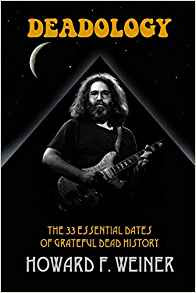
https://www.amazon.com/dp/B07R6Q39J4/ref=dp-kindle-redirect?_encoding=UTF8&btkr=1


Saturday, April 18, 2020

Deadology Outtakes 4-14 +17

These dates didn't make the 33 Essential Dates of Deadology, but they came close. 
                                                                   April 14
“When we’re done with it, they (Deadheads) can have it,” said Jerry, in response to David Letterman’s inquiry about the wisdom of letting fans tape their concerts. A night after playing the Nassau Coliseum, Garcia and Weir appeared on Late Night with David Letterman on April 13, 1982. Wearing a light blue sports shirt, Weir looked like a preppy hipster, not a rock and roll veteran who had experienced the Acid Tests decades earlier. Chain smoking through the fifteen-minute spot, Garcia appeared like a smiling beard dressed in black. After some light -hearted banter with Letterman, Jerry and Bob played fine acoustic versions of “Deep Elem Blues” and “Monkey and the Engineer.” After their TV rendezvous, they headed north for their next show in the Glens Falls Civic Center.
On April 14, 1982, I headed north on the New York State Thruway and met some friends at the State University of Albany, and then boarded a party bus bound for Glens Falls. I had a tenth-row ticket for the show, and to enhance my enjoyment of the music, I ingested some potent mushrooms before the show. Everyone in the rows in front of us were standing on their chairs, so I spent the entire night standing on a tiny seat cushion trying to balance myself as I chain-smoked Marlboros. I’ll never understand why at some shows, people feel the need to stand on chairs. The whole show I was fried out of my mind to the point where I couldn’t focus on the music—pure fear and loathing. Later that evening, I found myself at a post-show party coming down from the shrooms, drinking a Molson Ale, and rocking out to a hot “Jack Straw.” I asked the host where the tape was from, and with a proud smile, he said, “That’s tonight’s show.”
            I may have missed the performance from my tenth-row seat, but I’ve spent the past thirty-five years enjoying the soundboard recording of 4-14-82, especially the first set. The band started late. Weir announced that “certain members of the rhythm section didn’t make it here on time.”  The “Jack Straw” opener more than makes up for the drummer tardiness. The urgency in this “Straw” jam is unbelievable. It’s not long, but the intensity is gripping start to finish. Phil is blasting as Bob and Jerry strum madly—a demonic release. The jam is at the same time elegant, and as subtle as a ballpeen hammer to the skull. Weir and Garcia howl, “Jack Straw from Wichita cut his body down. Dug for him a shallow grave and laid his body down. Half a mile from Tucson by the morning light (Phil and Jerry wail away) …We can share the women we can share the wine.” Perfection!
            Jerry spins a gorgeous two-tiered solo in the funkiest version of “They Love Each Other” since 1973. Me and My Uncle > Big River romps and stomps, opening the flood gates of Old Weird America. With Jerry and Bobby’s appearance on Letterman fresh in their minds, the Dead deliver “Deep Elem Blues.” Every guitar note, and every syllable from Jerry crystalizes and flows from the soul. Between ’81 and ’83, the Dead played their last seven electric versions of “Deep Elem Blues,” and I saw three of them. Yes, I saw 4-14-82, even if it didn’t register it in my shroom zoomed mind.
            I’m raving about this set, but the best is yet to come. Song for song, “Little Red Rooster” is the undisputed champ of Glens Falls, and hands down, the best-ever version. Garcia’s double-solo rampage could make Eric Clapton blush. If you’re not familiar with this “Rooster” solo, make a point of checking it out, and while you’re at it, enjoy one of the elite first sets of the year.
Jerry was an amiable talk show guest the night before. On this evening in Glens Falls he was transcendent—Dear Mr. Fantasy in the flesh. On the heels of “Rooster,” the band rips a robust “Brown-Eyed Women.” If you can deal with another best-ever version, pay homage to the Glens Falls Lazy Lightning > Supplication. This “Supplication” jam has the primal power of ’69 Dead.  There’s a brief pause prior to the band launching “Bertha.” Magic! “Bertha” as a set ender could never sound sweeter than it did as part of this brazen presentation.  
            The level of professional execution never waned in set two, but the raging pulse of the music eased as the Dead opened with China Cat > Rider. As Jerry thrills Glens Falls with the exotic “China Cat” intro, he accidentally, or intentionally, misses one note. Jerry instinctively works the silence to his advantage and puts a new spin on a familiar lick. This “China Cat” is long, luxurious, and moody. It’s one of the best post-1974 “Cats.” For Catheads, I’d also recommend 3-9-81 MSG and 8-7-82 Alpine Valley. The Glens Falls “I Know You Rider” is smoldering lava.
            The band had conquered and pillaged. The time had come for them to bask in the weirdness of “Playin’ in the Band.” It’s a heavy jam that leads nowhere and dissolves into Drums. The Wheel > Miracle > Black Peter > Playin’ reprise is well done but the set is too short. Maybe they were up against a curfew due to the late start. If you take the Gens Falls first set and combine it with the second set of 4-6-82 Philadelphia, you’d have the ultimate historical document of the Dead on top of their game in 1982.  
            Let’s flashback ten years. The Grateful Dead’s crusade through Europe finds them in Tivolis Koncertsal, Copenhagen, Denmark on 4-14. Since the song selection of this show is similar to 4-8-72 London, I’m going to cut straight to the meaty part of the second set. Following an innocent presentation of “Looks Like Rain,” it’s time for an episode of mind-twisting theater. “Dark Star” is the vehicle, and by this point in the tour, the band knows that something supernatural is happening here. Garcia’s latches on to an idea, squeezes a few thrilling musical paragraphs out of it, and repeats the process, each paragraph has more pizzazz than its predecessor. You wonder if a verse of “Dark Star” will ever be sung. The music fades into a vortex of nothingness, and then Garcia picks up the intuitive again leading the band from darkness to astronomical brightness as one lovely lyrical lead piles on top of the last, and they’re back in orbit: “Dark Star crashes, pouring its light into ashes.”
            It took seventeen minutes to land “Dark Star” for a verse, so Billy strikes an upbeat tempo that keeps the band from straying off course. Garcia and Lesh pick away as a “Feeling Groovy” jam briefly emerges. The momentum pulses forth until, suddenly, at the twenty-nine minute mark, the band cuts into “Sugar Magnolia” without any of the romance of the 4-8-72 Star > Mag transition. But that’s all right because this “Sugar Mag” shakes and bakes the ancient city of Copenhagen.
            It’s an interesting change to hear “Good Lovin’” instead of “Caution” after “Sugar Mag.” Pigpen gives us a Good Lovin’ > Caution > Who Do You Love > Caution > Good Lovin’ medley. This is impressive but the 4-8-72 “Caution” is a superior piece of music on its own. For kicks, the Dead tack on “Ramble on Rose” and a smoking NFA >GDTHRFB > NFA to the end of this epic set in the thick of their European adventure.
            The other two Dead shows on this day from the ‘70s takes us back to school. There’s a performance at Virginia Polytechnic University in Blacksburg on 4-14-78. Towards the end of the first set the Dead play the only “Dupree’s Diamond Blues of the year. An alluring old-timey feel is prevalent throughout this version, and Jerry and Donna sound great on vocals. On the negative side, there are no solos! “Dupree’s” wasn’t played again until 1982. Garcia lacks fire and creativity on the set ending “Music Never Stopped.” The top jam of the short second set is “Dancin’ in the street” in the third spot before Drums.
            Faring better on 4-14-71, the Grateful Dead rocked a consistent show at Bucknell University in Lewisburg, Pennsylvania. More than any particular performance, or standout solo, this show has a seductive flow and song sequence that gives it collective charisma and makes it one of the sweetest tapes from this tour. The Bucknell show begins to soar mid-set with the Dead’s third performance of “Sing me Back Home.” Garcia’s yearning vocal unlocks the beauty of this melancholy tune as he implores his guitar playing friend to “Sing me back home with a song I used to hear. Make my old memories come alive. Take me away and turn back the years. Sing me back home before I die.” Jerry bends his strings for a bittersweet solo.
            Garcia’s guitar rings out and sparkles during China Cat > Rider. Riding the momentum, they swing into a soulful groove for their third version of “Second That Emotion,” which bridges Cat > Rider to the set ending “Casey Jones.” Both sets of 4-14-71 Bucknell have the feel of a well-conceived album. Set two features a sensational opening solo in “The Other One,” and a strong “Hard to Handle” after “Wharf Rat.” I like hearing “Handle” late in set two. In the week to come, the whole scope of “Handle” would change as it transforms from a grooving Otis Redding jam to a show stopping masterpiece. This happens in Providence a week later, and I will pontificate on that topic when we reach April 21.

            Of the three ‘80s gigs on this day, 4-14-84 Hampton Coliseum and 4-14-85 Irvine Meadows have noteworthy performances. I was in Hampton on April 14 for the second show of the East Coast tour. Physically, Garcia was in poor shape and it took the band a while to heat up. “Let it Grow” ends a short first set with some garrulous and grandiose guitar improvisation. After Drums, “Morning Dew” arises out of space. Garcia’s voice is a touch depleted. He makes up for that by belting out the anthem out with deep emotion, and Healy turns up the echo and reverb. Both solos are gripping, and Brent’s organ playing is the catalyst for a moving final jam. Garcia wants to split as he breaks into a “One More Saturday Night” riff, but Weir vetoes that and keeps the band on stage a little longer with Throwing Stones > Not Fade Away. This thirteen-show tour also featured excellent “Morning Dews” from 4-20-84 Philadelphia, and 4-26-84 Providence. Garcia’s voice was shot in Providence, but that final solo is heroic, definitely an elite “Dew” jam.
            120 years before the Dead played in Irvine Meadows Ampitheatre on April 14, 1985, President Abraham Lincoln was assassinated, shot while attending a play in Ford’s Theatre. The only shots heard in Irvine Meadows ’85 were the creative triple shots to start off all four sets. On 4-13-85, the first Irvine Meadows show commences like a speeding bullet with Why Don’t We Do It in the Road > Bertha > Jack Straw and set two takes off with Terrapin > Playin’ > Crazy Fingers. Good times with triplets continue on 4-14-85 with a Touch of Grey > Hell in a Bucket > Sugaree opener and set two has an I Need a Miracle > China Cat > Rider blastoff.

            As enjoyable as it must have been to be in Irvine Meadows on 4-14-85, the X-factor doesn’t take hold until the band breaks into “Dear Mr. Fantasy” after Drums > Space. This Traffic classic started out as a vocal duet by Jerry and Brent in June ’84, but now this was Brent’s baby. Garcia rips a solo and Brent follows with one of his own before the band charges into “The Other One.” It’s a concise version with Garcia and Lesh on fire before the opening verse, between verses, and after. A surprisingly up-tempo “Wharf Rat” segues into a rowdy “Sugar Magnolia.” The crowd is thrilled with the “Gloria” encore. This is the fourth version of “Gloria,” and it’s played as an encore for the first time. Energy ripples through this rock and roll spelling bee. When the Grateful Dead are on their game on nights like this in 1985, the music is exhilarating—a sonic psychedelic train high on cocaine in the express lane.

                                                            April 17


            Deadheads converged in the Niagara Falls Civic Center to see their heroes on April 17, 1984. This was the Dead’s only appearance In Niagara Falls, and it gave tour heads a chance to soak in the majesty of the falls which straddles the U.S./ Canadian border. Who in their right mind would travel to Niagara Falls and not take the time to view this wonderous sight? I wasn’t in my right mind when I arrived in Niagara Falls on April 17. After driving to Hampton, and then all the way to Rochester for the first three shows of the tour, I was exhausted and burnt to the bone by the time I checked into the Niagara Falls Holiday Inn. While the rest of my crew took acid and went to see the falls, I passed out and dreamed of Jerry, and the jams that were merely a seed in his mind. I was in a strange young man in 1984. Being well rested for a hot “Jack Straw” was more important than seeing Niagara Falls.
            The ceremony begins with “Jack Straw.” Garcia’s peppering the jam, notes are fluidly flying this way and that way. This is going to be an enormous “Straw,” but out of nowhere Weir pulls the plug, “Jack Straw from Wichita cut his buddy down.” Oh well, maybe next time I’ll hear that killer “Straw” I was dreaming of. The set rolls on and nothing extraordinary happens until the eighth and last song of the set. Nobody pulls the plug on Garcia during “Deal” as he works over the fretboard for a satisfying conclusion to the set.
            To ease the crush of the crowd, the band starts the second set with a brief “Take a Step Back” march. It’s ironic, but almost every time the Dead asked the audience to take a step back, they would follow that by playing something outrageous, sending the crowd in a state of delirium. If you’re going to be smashed by the masses, you might as well experience transcendent music. After their plea to the audience, the Dead bounce into “Help on the Way.”
            Garcia’s guitar dominates with a demonic tone and Coltrane like flow as the band ascends into “Slipknot.” Garcia’s playing is borderline belligerent in a redeeming way. His communique to his fellow band mates is “follow me if you can.” Fragments of the “Slipknot!” melody are explored and magnified. Garcia’s zipping through scales, striking up dark chord riffs, and milking the licks that he likes during this aggressive yet smooth nine-minute “Slipknot”.
 “Franklin’s Tower” isn’t as pretty as it is gritty. The band sounds a little detached in the first half, but they rally with a ridiculously hot jam near the end making this a contender for best Help > Slip >Franklin’s of the year. After “Women Are Smarter,” “Eyes of the World” is an exciting follow-up, but there’s no meat on the bones of this sloppy offering. On the other side of Drums, space segues into “Black Peter,” making that a rare five of six Jerry tunes to start set two. Throwing Stones> Not Fade Away concludes a set that ran out of gas after Slipknot > Franklin’s.
            On April 16 and 17, 1983, the Dead played their first gigs in the Brendan Byrne Arena in the Meadowlands Sports Complex located in East Rutherford, New Jersey. Located ten miles from Manhattan, and 90 miles from Philadelphia, this building, and the adjacent Giants Stadium, became hotbeds for Dead shows as their rabid East Coast fans electrified and inspired the band.
            The first set of 4-17-83 has a smoking “Little Red Rooster” in the two-hole. Garcia’s double decker solo awes the Brendan Byrne Arena. Hot “Roosters” from Garcia became a rarity after this show. I guess the thrill was gone. Jerry keeps the set suspenseful with an unexpected “Dupree’s Diamond Blues” in the third spot. “Cassidy” and “Big Railroad Blues” back to back in the thick of the set keeps the mojo rolling. A late set “Peggy O” gives way to “Let it Grow.” The nuances of song selection on 4-17-83 enhance the performances, and the enjoyment for seasoned aficionados. Typical of “Let it Grows” from the period, this one delivers a welcomed abundance of virtuosity from Garcia. Brent is very active, sprinkling tasty keyboard fills behind Jerry. Having too good of a time to head off for break, the Dead finish the eleven-song set with “Might as Well.”
            Help > Skipnkot!> Franklin’s on 4-17-83 is a stronger group effort than the one from Niagara Falls. Exhilaration fills the Brendan Byrne as the band confidently and gracefully transitions and weaves through their masterwork which had been in hibernation for six years. This was their fifth rendition since breaking it out a month earlier, and it’s one of the best up to this point. As “Slipknot!” winds down and the bridge is built towards “Franklin’s,” it sounds like astronauts are successfully navigating their way back into the Earth’s atmosphere, and the thrust into “Franklin’s” triggers the ticker-tape parade on Broadway. The power of the 4-17-83 “Franklin’s Tower” builds incrementally, and there’s a screaming solo at the end of the parade route.
            Stephen Stills joins the festivities after Drums > Space. The evening before he appeared in the same spot and played “Black Queen.” On this night he played another tune off Stephen Stills, his iconic, and vastly underrated solo album. Everybody knew the tune they were playing, “Love the One You’re With,” even though it was a raw and choppy performance. Stepping into the Grateful Dead Universe is rarely an easy experience regardless of your rock and roll pedigree. Garcia worked in a succinct solo, and Stills stepped aside as “The Wheel” began to spin. After a thunderous “Playin’” reprise Weir segues into his pride and joy, “Throwing Stones,” which of course, segued into “Not Fade Away.” This was my third time seeing this combo, and I was already loathing it. There were few things less interesting than a crappy cookie cutter version of a formerly great song, but on this night Stills came back on stage and the jamming was much better than usual. This is another outstanding show in a year that doesn’t get enough respect. 
            April 17 often finds the Grateful Dead in the thick, or towards the end of a spring tour as it did on 4-17-82 in the Hartford Civic Center. A show in Hartford or New Haven means a hot “Sugaree” is likely, and The Boys deliver after they open with “Minglewood.” Jerry gives us three solos, but they all just miss being noteworthy. If you look at this show on paper, or listen to the tape, there’s nothing wrong with it, but Jerry walks most of his jams to the precipice of ecstasy, yet never brings it on home. This show doesn’t compare to the great nights already discussed from this tour: 4-6-82 Philly, 4-12-82 Nassau Coliseum, 4-14-82 Glens Falls. However, I’d recommend listening to the 4-17-82 “Shakedown Street” that opens set two in Hartford. During the big ending jam, Garcia and Mydland trade licks as the did in Philly on 4-6-82. Brent’s playing is extraordinary as Garcia plays repetitive funky licks. The jam took on a Miles Davis quality where Brent had an opportunity to shine as if he was Herbie Chick Correa. If Jerry wasn’t feeling good or zonked out, I could empathize. I was at home taking antibiotics and nursing bronchitis after the Glens Falls show three nights earlier. The Hartford affair was one of those ‘82 shows that was professional yet lackluster. The band was super tight most of the year, and on some nights, Garcia was content to ride that wave.
            In addition to playing three consecutive years on April 17 in the ‘80s, the Grateful Dead played that date consecutively from 1969 – 1972, with the first and last of those shows being the most rewarding. In the middle of April ’69 the band’s rambled through the Heartland and landed in St. Louis to play Washington University on 4-17. The show starts with a “Hard to Handle” tribute for Otis Redding. This was the their fifth “Handle,” a raw foray with Jerry playing slide guitar. The show rolls along with adequate renditions of the usual suspects: “Morning Dew,” “Good Morning Little Schoolgirl,” “Dark Star.” A sparkling “It’s a Sin” is sandwiched inside “St. Stephen.” The return to “St. Stephen” is awkward, and consequently, they never went down that road again.
            “That’s It for the Other One” is outrageous all the way—unholy alchemy to open the second set. The Dead raged into “Caution” and the plug was literally pulled before they were two minutes in, by order of the cops. An extraordinary finish to the set was nullified. This show was released as Volume 12 of the Download Series. The bonus tracks on that release are rehearsal performances of “The Eleven” and “Dupree’s Diamond Blues” from the Avalon Ballroom. These are stunning performances played with same temperament that the band had on 4-17-69. Awesome selection and editing!
             Johnny Cash played in Washington, D.C. on 4-17-70. This was stranger than anything the Dead did in Washington University a year earlier. The Man in Black performed “A Boy Named Sue” for Richard Nixon in the White House—weird, whacky times in America.
            The best of the rest of the April 17 shows brings us back Europe ’72 and another night in Copenhagen. This Tivoli show opens with a gorgeous “Cold Rain & Snow” that trickles down like snow flurries on Christmas. The piano runs by Keith are heavenly. As much as I love the wildness of ’69, this is special, beyond what they were capable of St. Louis, or a year earlier in Princeton University’s Dillon Gym on 4-17-71.
The music and song selection are incredible in Tivoli. “Me and Bobby McGee” is tender and succulent. “China Cat” would go on to have longer jams, but the aura and essence of the performance is divine in Copenhagen. Phil’s bass blasts open the sonic landscape to new dimensions as Keith and Garcia fill the vacuum with splashes of Asian art. Tivoli gives us the debut version of “He’s Gone,” a sly shuffle that would morph into a heart-tugging dirge. This is a three-set show, and the opening set concludes strong with “Black Throated Wind.” Parts of the first set, and the entire second set were recorded for Danish TV.
The ever expanding “Playin’ in the Band” kicks off set two. Although it’s a few years away from becoming an iconic Garcia guitar extravaganza, “Sugaree” is stunningly sweet. The performances of “It Hurts Me Too” and “Ramble O\on Rose” are robust and album worthy, although nothing from this show ended up on Europe ’72. For a band performing at peak professional levels, they were still pranksters at heart as they donned clownish masks before tearing into “Big Railroad Blues.” A spiraling, breathtaking jam brings “Truckin’” and set two to a rousing conclusion.

In between the Tivoli shows, the Dead played at Aarhus University, Denmark on 4-16. The college crowd was treated to a rocking affair, but Tivoli was treated to “Dark Star” on both nights. Dark Star > Sugar Magnolia > Caution comprises set three on 4-17-72.  Garcia’s guitar howls at the moon as “Dark Star” lifts off. His sublime playing tranquilizes the audience, and future listeners. There’s no jarring twists or movements, just a straight line of virtuosity until Garcia lovingly croons, “Dark Star crashes.” The post verse jam builds slowly with the same serene tone as earlier. Jerry and Keith play off each other delicately as the sound piles up like leaves falling from trees. Twenty-five minutes disappears as the listener is drawn into blissful trails.
            A jarring movement begins to develop towards the end of the 4-17 “Dark Star.” Even though the band hasn’t composed “Let it Grow” yet, Weir and Garcia strike up a rhythm like the opening of “Let it Grow,” and Lesh blasts his bass as if they’re segueing from verse to solo. This tinkering goes on four three of four minutes until the band jumps into “Sugar Magnolia.” “Dark Star” was an extreme rarity throughout most of the ‘80s. Yet there was no shortage of sublime playing that can be traced back to “Dark Star.” It’s there in the 4-17-84 “Slipknot!” and the 4-17-83 “Let it Grow.” 

https://www.amazon.com/Howard-F.-Weiner/e/B007A561UG%3Fref=dbs_a_mng_rwt_scns_share


6-16-82 MUSIC MOUNTAIN: THE GRATEFUL PILGRIMAGE

  In honor of the anniversary of Music Mountain, here’s chapter two from my latest work, The Grateful Pilgrimage: Time Travel with the Dea...